 The Big Meltdown
|
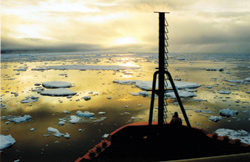 |
| A view of polar ice melt from the U.S. oceanic research ship Laurence M. Gould in the Antarctic Peninsula’s Gerlache Straits. |
| © Colin Woodard |
What he saw, Skvarca recalls, was astonishing. “The surface of the ice shelf was almost totally covered by melt ponds and lakes, and waterfalls were spilling over the top and into the ocean,” he says. Great slices of the Larsen-B’s leading edge had broken off, filling the Weddell Sea with icebergs and slush. Two weeks later, almost the entire ice shelf had disintegrated. “It was unbelievable to see how fast it had broken up. The coastline hadn’t changed for more than 9,000 years and then it changed completely in just a few weeks.”
Now scientists studying the aftermath of the collapse say it will very likely have unpleasant implications for the rest of us. The collapse of the Larsen-B and its smaller northern neighbors, the Larsen-A and Wordie Ice shelves, in the face of warmer summer temperatures has caused the vast glaciers and ice sheets behind them to begin sliding into the sea at a remarkable pace. Aerial and satellite imagery show that the glaciers behind the Larsen-B increased their seaward flow by two to six times in the months after the ice shelf’s collapse, with some of them thinning by more than 100 feet. Unlike the floating ice shelves, thinning glaciers contribute to global sea-level rise.
“The glaciers took off like a race horse after the ice shelves were removed,” says Ted Scambos, a researcher at the National Snow and Ice Data Center in Boulder, Colorado. “Just a decade ago we glaciologists were talking about gradual changes in glaciers taking place over centuries. Now we’re seeing things that we didn’t think glaciers could do in terms of their speed of response.”
And it’s not just happening on the Antarctic Peninsula. Similar studies of glaciers entering the Amundsen Sea, some 1,200 miles away in West Antarctica, show them doubling their flow since the 1990s. This is especially worrying because the glaciers in this area drain the West Antarctic Ice Sheet, a precariously balanced portion of the southern ice cap that contains enough ice to raise sea levels by 20 feet. By comparison, the sea-level rise predictions endorsed by the 2,600 scientists of the Intergovernmental Panel on Climate Change are only about two feet by 2100.
If anything, the news from the Arctic is even more troubling. In November an international team of 300 scientists completed an unprecedented four-year study of the region that found it is warming at nearly twice the rate of the rest of the planet. Average winter temperatures in much of the region have increased by as much as four to seven degrees Fahrenheit in the past 50 years, and they are expected to warm by another seven to 13 degrees by the end of the century. During that time, the scientists predict that half of the Arctic’s summer sea ice will melt, along with much of the Greenland Ice Sheet, which contains enough ice to raise sea level by some 23 feet.
“The preponderance of evidence suggests that the warming of the past 50 years has mostly come from greenhouse gas emissions and everything we’re seeing in the Arctic is 100 percent consistent with that,” says Robert Corell, a senior fellow at the American Meteorological Society in Washington, D.C. and chairperson of study for the Arctic Climate Impact Assessment.
Arctic people are already feeling the effects of this polar thaw. Several Inuit communities in Canada, Alaska and Russia are washing into the sea because the sea ice that used to dampen waves is vanishing. The area covered by sea ice has shrunk by more than six percent since 1978. And in the central Arctic, submarine measurements indicate that the average thickness has declined by 40 percent in recent decades. If trends continue, scientists warn that polar bears, seals and other animals northern people rely on will be driven towards extinction.
Until recently, many parts of the Arctic were more accessible in winter, when ice roads made truck transport possible. But warmer temperatures are turning those roads into impassable tracks of mud for more and more of the year. Over the past 30 years, the Alaskan Department of Natural Resources has been forced to halve the number of ice road travel days from 200 to 100. In northern Russia, melting permafrost has damaged roads, railways, apartment buildings and airport runways and ruptured several oil and gas pipelines.
In Iceland and Greenland, glaciers have been in rapid retreat, with the Greenland ice sheet experiencing summertime surface melting over 16 percent more of its surface area since 1979. “Greenland is melting much more rapidly in the past two or three years than anyone imagined possible,” Corell says. “The ice is so bad in eastern Greenland that people are killing their sled dogs because they cannot hunt enough seal to keep them.”
After the report’s release, Shelia Watt-Cloutier, the Nunavut, Canada-based chairperson of the Inuit Circumpolar Conference, traveled to Washington to urge the Bush administration to take global warming seriously. “By looking at what is already happening in remote Inuit villages in Alaska…you can understand the future dangers for more populated areas of the world such as Florida, Louisiana or California,” she told a Senate committee hearing. “Use us in the Arctic as your early warning system.”
CONTACTS
Arctic
Climate Impact Assessment
Phone: (011)+47-22-85-87-84/50
The
Antarctic and Southern Ocean Coalition
Phone: (202) 234-2480