Global Issues >> Overview >> Global Energy Grid - The Details
Global Energy Grid - The DetailsIndex:
There is an existing, viable technology that, when developed to its highest potential, can:
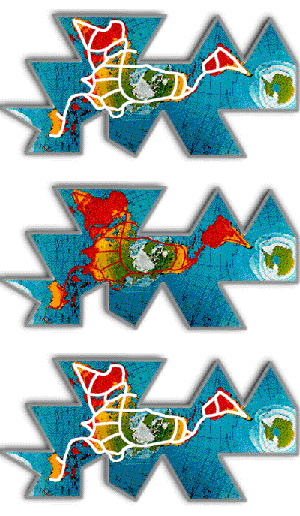
One Man's Vision: Energy AbundanceOver two decades ago, inventor, scientist and mathematician R. Buckminster Fuller proposed interconnecting regional power systems into a single, continuous world electric energy grid. While this global vision is still years away, technological advances over the past two decades have made the linking of international and inter-regional networks practicable today. The origin of this initiative emerged from the global simulation of the World Game™. The World Game™ eliminates politics, prejudice, war and human ignorance, and has as its purpose:
All the earth's resources were catalogued, and human survival needs were assessed, giving world planners the potential for global thinking and solutions. Upon realizing that electricity was the common denominator of all societal infra-systems: food, shelter, health care, sewage, transportation, communication, education, finance - the priority of delivering sufficient power to every human was established. Access to electricity for everyone is a primary measure of a modern society.
Technological development now moves power further and cheaperThirty years ago, electric power could only be efficiently transmitted 600 kilometers. Breakthroughs in materials science extended this transmission distance to 2500 kilometers. This allowed utilities to interconnect across time zones and compensate for variations in seasonal demand. The buying and selling of power is now common, because utilities desire to level the peaks and valleys of energy demand. Today, research shows the efficient distance of ultra-high voltage (UHV) transmission to be 7000 kilometers for direct current, and 4000 kilometers for alternating current. This would allow for power interchange between North and South hemispheres, as well as East and West. Because of electricity's link to a quality standard of living, the interconnection of regional power grids became the highest priority objective of the World Game.
A Win-Win Solution to Global ProblemsExpanding power grids has proven to be both economically and environmentally desirable. Presently, 80% of all power generation is non-renewable, causing many of the world's environmental ills -- greenhouse gases, acid rain, toxic wastes. Yet, enormous potential for hydro, tidal, solar, wind and geothermal sites exist around the world. These are oftentimes in remote locations, but within economic transmission reach. Today, as peak power is often purchased from a neighboring utility, the most inefficient, expensive and polluting generators are being phased out. Billions of dollars are presently being saved through shared power, and much of the future demand can be met from wheeled electricity, rather than constructing the next power plant. These savings are reflected in reduced customer costs, while expanding markets for each power producer -- a massive win-win situation. In most developed countries, end-use efficiency is the priority. However, demand-side management for the developing countries is difficult when their energy demand is rapidly increasing. One does not become environmentally concerned until survival is handled. Efficiency savings are important, yet only part of the solution.
Improving the Quality of LifeThe potential of UHV technology to the developing world is immense. Exports of excess capacity can be purchased by the industrialized world, providing cheaper and cleaner power for the North, and sending needed cash to the developing world. Comparative trend analysis shows striking improvement in all major societal indicators as electricity becomes available for developing societies. When food and health care systems can be sustained, infant mortality rates decrease, as do birth rates. When fewer children die from hunger related causes, fewer "insurance births" are required to ensure care for the elderly. Projections that the population bomb would cease and hunger would end when the Energy Grid is in place appear to have merit. The average life expectancy of fifty years for many developing nations would also increase. Note: What's needed today in most villages are small decentralized generators that can meet basic food, water and health care needs. As development demand increases, the population can connect into the expanding grid network.
Building Bridges: Swords to PlowsharesAs a high-tech global initiative that benefits everyone, the Energy Grid is ideal. Since international cooperation is required, political tensions and fears would be diminished. Many experts suggest that peace is enhanced when friend and foe trade with one another. Already over 50 nations are linked with neighboring countries, predominately throughout Eastern and Western Europe and North America. One focused project of GENI is the interconnection between Israel and its Arab neighbors, which is now proceeding after the Israeli/PLO Peace Accords. Two months after the fall of the Berlin Wall in 1989, East and West Germany initiated the linkage of their grids, and all of Europe is slated to be interconnected in the next decade. GENI has opened the dialogue for the South-to-North linkages of Latin America to North America and from Africa to Western Europe. Siberian Russia and North America have enormous untapped renewable capacity. This hemispheric interconnection would transcend political differences, being economically and environmentally beneficial for both nations. Given the technical and engineering expertise required, the capital, resources and brainpower could lead the economic conversion from a military-industrial base to civilian-oriented economies.
Costs vs. Benefits Cost estimates of the Bering Strait intertie are
less than 5% of the US/Russian combined annual military
budgets. Both short and long term benefits
dwarf this figure, and experts from both countries
have begun to investigate this scheme. Of critical
consequence for the planet is choosing the appropriate
energy path for India, China and Southeast Asia. Over
half the world's population lives here, and linking
renewable resources is essential if we are to reduce
atmospheric emissions. Leading to the Earth Summit,
the United Nations Environmental Program called the
Energy Grid
What's MissingThe purpose of GENI is to ask the question: if the technology exists, and the economics make sense, why haven't we done it? Politics, bureaucracy and nationalistic thinking are the barriers. What's missing is an informed public who can influence political will. GENI has facilitated the expert corroboration of this global vision and is working to educate all people of this viable option. If all
nations and people knew there was another global option,
another alternative, what
would they do?

|