 Global Issues >> Overview >> GENI History GENI History - A Credible Foundation
INTRODUCTION
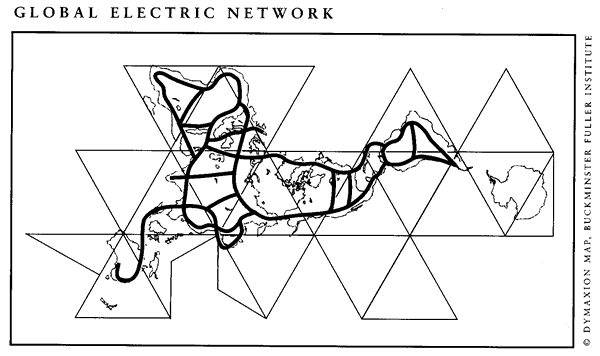
Global Energy Network Institute was founded in 1986 by Peter Meisen to investigate the idea of Dr. R. Buckminster Fuller, proposing a global electric energy grid as the number one priority to solve many of the world’s most pressing problems. In 1991, GENI was incorporated in San Diego, California, as a 501(c)(3) non-profit corporation to conduct research and education related to a compelling and technologically feasible global energy strategy that addresses fundamental issues of quality of life, energy efficiency and sustainable development. That strategy is to interconnect electrical power grids between countries and continents, thereby creating an interconnected global energy grid, with an emphasis on linking local and remote renewable energy resources (wind, solar, hydro, geothermal, tidal and biomass). The focus is on electricity and its sources because of their relationship to all the major measures of a sustainable society and environment.
GENI's mission is to accelerate the attainment of optimal, sustainable energy solutions in the shortest possible time for the peace, health and prosperity of all. In considering the decision-making processes of the global electricity industry, four areas of activity were identified to accomplish GENI’s mission:
ESTABLISHING CREDIBILITY
In the initial phase, GENI established
the technical feasibility and validity of this
Global Grid Initiative. In 1991, in cooperation
with the Manitoba HVDC
Research Centre, GENI hosted the Six months later, in January of 1992, Russians
and Americans meet in Anchorage, Alaska to discuss
Also that same January, the Institute of Electrical
and Electronic Engineers, Power Engineering
Society (IEEE/PES)
hosted a panel session in New York on Convinced of the validity of this initiative, a long and productive affiliation with the IEEE/PES began, defining a new phase for GENI of creating awareness and technological corroboration around what is now referred to as The GENI Initiative With GENI’s collaboration in organizing topics and speakers, numerous panels between 1992 and 1998 focused regionally on the long distance interconnection of electrical grids linking remote renewable resources. Following is a list of articles resulting from those panels and published in the IEEE/PES Power Engineering Review over a period of several years. Over 23,000 engineers involved in research, manufacturing and utility planning receive this publication.
GENI has focused on researching the development of transmission and distribution networks as a viable option to meet our global energy requirements. These panel sessions and subsequent articles provided a body of technical evidence for the feasibility, efficacy and desirability of The GENI Initiative. Clear evidence indicates that large scale, remote renewable energy resources could be made available via high-voltage transmission. GENI continues to work with the electricity industry to explore the implications of interconnections around the world.
In early 1993, evidence began to surface that GENI’s message was being recognized.
Months later, in January, Mechanical Engineering, trade magazine of the American Society of Mechanical Engineers, ran a feature story: "Connecting the world's electrical grids. Transmission systems that send bulk power over long distances are proving that global energy networks are technically feasible if economic and political incentives surge." By mid 1995, interconnecting electrical grids
was no longer a strategy needing proof, but
was now a phenomenon to be reported. The
New Scientist, a major scientific publication
of the commonwealth countries, featured EDUCATING THE PUBLIC AND THEIR REPRESENTATIVES
The second area of activity for GENI has focused on educating the general public regarding The GENI Initiative and on building collaborative relationships with individuals and organizations. The following were the main projects to accomplish these objectives:
REACHING THE POLICY MAKERS
A third key area in accomplishing The GENI Initiative has been educating our policy makers. Primarily this took the form of sending our annual newsletter to every president, prime minister, energy minister, environment minister, and U.N. Ambassador in the world. In addition, when issues like the conflict between North and South Korea and peace talks between Israel and Syria arose, GENI was proactive in writing to the key decision makers to present the interconnection of their electrical grids as not only a possibility resulting from their accord, but also as a mechanism for driving the peace process. A win-win business opportunity engenders cooperation.
In the initial ten years of its existence, GENI has accomplished its first level of objectives: technological credibility of its Initiative, public awareness and relationship with other organizations, and education of world leaders regarding this Initiative. GENI has now entered a new phase in which we will play an even more proactive role in causing its purpose to be realized. COMPREHENSIVE ANTICIPATORY DESIGN SCIENCEWhat is Comprehensive Anticipatory Design Science and why is it relevant and critical in the today’s world? From a global perspective, we are faced with daunting challenges as documented by World Resources, 1996-1997: the accelerating confluence of population expansion, increased demand for energy, food, clean drinking water, adequate housing, the destructive environmental effects of pollution from fossil fuels and nuclear waste, plus the growing divergence between the haves and have-nots and the potential for ensuing conflicts. Only recently have national elected officials realized what global corporations already know: the issues of today and the future transcend political boundaries and nationalistic thinking and are globally interrelated, affecting each other in multiple ways.
When viewed as a whole, solutions arise that
address multiple, interrelated issues in ways
that otherwise would not be apparent if addressing
each issue in isolation. Some strategies must
be global, and any investigation into global
solutions must, therefore, be comprehensive.
Population growth, energy demand and pollution
are predictable as trends. Planning must anticipate
these trends if we are to find solutions that
can stay ahead of them. We then ask the engineers
and architects to design systems
that will enable us to provide a desired quality
of life. Appropriate design must include consequences
for natural resource use, cost efficiency and
human factors. The science includes
the proper scientific method and asking the
right questions from the beginning. GENI’s question
is Good design must also include awareness of universal scientific principles. Ideally, artifacts and tools can then be created so that old problems disappear, since the new design makes them obsolete. The computer replacing the typewriter is a good example. Comprehensive anticipatory design science acknowledges interrelatedness, trends and principles and then builds to meet today’s needs without compromising the needs and environment for future generations. This is exactly what The GENI Initiative does. Given current world conditions and evidence that supports the scientific soundness of The GENI Initiative, three projects have been designed which will forward its realization. GENI PROJECTS
Computer Simulation ModelAs a result of early research, GENI identified a major limitation for the industry's wider use of interconnection of large scale, renewable energy resources: the lack of a suitable, validated computer simulation model to demonstrate the cost/benefit of various scenarios which would include a comparison with other energy scenarios, for example, those of the World Energy Council. A Computer Simulation Model was conceived as this critical management tool. It would factor in quality of life indicators including infant mortality, life expectancy, literacy and safe drinking water, as well as criteria for meeting the environmental standards set forth by the Earth Summit Agenda 21 and signed by nations around the world.
In 1994, GENI presented the model to the Mission Earth Task Force of the Society for Computer Simulation (SCS). Several of the world's top modelers committed to assisting with the model. By November, the Mission Earth Activity endorsed and began advising the GENI Computer Model research project. GENI was featured in an article in Simulation, the SCS magazine, on "Simulation in the Service of Society." In April, 1995, GENI got the cover and feature article in Simulation: "The GENI Model: The Interconnection of Global Power Resources to Obtain an Optimal Global Sustainable Energy Solution." Based on this preliminary work, a full proposal was put together to obtain the funding necessary to complete the model. (Funding requirement: $1.6 million) Click here for details. Documentary Film "The Powerful Planet"To leverage our communication with the general public and in collaboration with the non-profit Earth Vision Productions, GENI initiated a Documentary Film Project. "The Powerful Planet" will be an hour-long film suitable for international broadcast media. Over 20 hours of expert interviews have been logged to date, and a production team is meeting regularly to advance this project to potential corporate sponsors. (Funding requirement: $325,000) Click here for details.
International Conference "CONNECT 2000"To accelerate bringing this global energy grid into reality, GENI is developing "CONNECT 2000" An International Conference on the Global Grid Initiative. The goals of this Conference are as follows:
(Funding Requirement: $525,000) Click here for details.
With there three projects in place, policy makers will have the management tools to make decisions that are comprehensive, that anticipate trends and the consequences of their decisions and can design systems that will make current problems obsolete. The public will be informed to understand and support policy makers in making decisions based on sustainability.
DIRECTORS & OFFICERS

|