|
What Happened to California's Blackouts?Published: Monday, 3 December
2001
by Patti Harper-Slaboszewicz
1. Cooler than normal summer weather. 2. Retail prices were raised significantly early in the summer 2001 for all customers of PG&E, SCE, and SDG&E. 3. 20/20 plan: customers in PG&E and SCE territories were offered a 20% discount on the bill if the customer used 20%
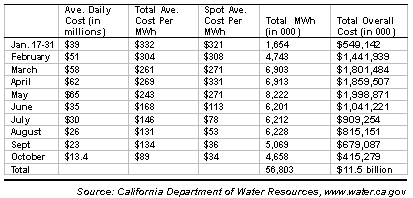
4. The combination of 2 and 3 above encouraged customers to conserve, and the customers responded much more than people had expected. People always refer to the zero-elasticity of electric demand. This means that customers continue to use the same amount of energy no matter what the price. This may still be true with small price movements but California retail prices were raised by 40% except for the baseline residential usage (the small amount of kWh allowed for each residential customer for basic needs, which varies from 150 to 400 kWh depending on the season and the climate.) 5. Commercial, industrial, and residential customers all wanted to avoid blackouts. When supplies were tight, as happened a few times, customers responded to avoid more blackouts. Commercial and industrial customers implemented energy saving consisting of reducing lighting, A/C, and computing loads. The California customers worked together to avoid blackouts. 6. The State of California launched a large advertising campaign for the 20/20 plan and energy efficiency programs. 7. Utilities such as PG&E and SCE had funds allocated for energy efficiency projects, such as funds for more efficient lighting, etc. This had been done for several years prior to 2001. For the first time, the funds were exhausted in the first year of funding. Customers came and checked out the energy efficiency plans, and implemented them. 8. This one should be higher on the list. The economic slowdown, now being labelled as a depression since March 2001, has reduced commercial and industrial demand, especially in the dot.com sector, which are intensive users of energy to support all the equipment to support an online operation. 9. This one might also be higher on the list. The DWR, Department of Water Resources, entered into long-term contracts to buy power for SCE and PG&E when it became apparent that the two utilities could no longer purchase power due to the deterioration of each company's credit. As more and more long term contracts were signed for power, DWR was relieved off continuing to purchase power to serve the PG&E customers and SCE customers on the spot market. Suppliers, in turn, were obligated by the contracts to produce power. This steadily decreased the percentage of power being purchased on the spot market. In other markets, only 6 to 10% of power for each day is purchased on the spot market. California utilities were buying almost all the power on the spot market. The regulated utilities had to do so by law, and that purchasing activity represents the majority of power deals to serve the needs of customers in California. As the dependence on the spot market decreased, and the supply of power increased, and the demand decreased due to the reasons listed above, the suppliers lost the incentive to withhold power to drive up prices. When most of the power was being purchased on the spot market, and when supplies were tight, there was an incentive, a large incentive, for energy suppliers to withhold power from the market. By withholding power, usually power available from less expensive power plants, the suppliers could drive up the spot market price. The suppliers sold less power but the price increase for the power the supplier was able to sell was large enough that the revenue from selling less power was more than if the power was not withheld.
It is not clear the power suppliers did anything illegal. Let's just say the incentive was there before the DWR entered into the long term contracts. With the long term contracts in place and with the lower demand, there was an excess supply of power, and it was no longer advantageous for power to be withheld. 10. No one will ever know, although many will postulate, what the dominate action was to reduce the prices and increase the supply. Some will say that the DWR did not need to enter into any long term contracts. I do not agree. I believe that the DWR long term contracts were the key to breaking the supplier power in the market. I liken the DWR contracts to the sale of stock at a lower price than the purchase price. Until the investor sells the stock at the lower price, the loss is just a paper loss. When the sale is complete, the loss is no longer theoretical but real. The DWR contracts were the sale of the stock but were not the reason the stock price fell. DWR did not cause the problem in California -- DWR was the unfortunate agency that got the job of revealing the cost of poor market design for deregulation that had been adopted.
e-mail: power@frost.com
|