From Africa Renewal, Vol.18 #4 (January 2005), page 6Energy key to Africa's prosperityChallenges in West Africa's quest for electricityBy Itai Madamombe On the outskirts of Accra, Ghana, business plans are only as final as the next electricity outage permits. In July, food tins at the Prime Pak canning factory were positioned on the assembly line, ready to be sealed before export. Without warning, the machines came to a screeching halt, leaving entrepreneur Cyril Francis standing helplessly in the dark. Thirty per cent of the consignment spoiled. "The worst part is not knowing when the blackouts will hit. When you least expect it, everything comes to a standstill," Mr. Francis told Africa Renewal from his factory, based in Dodowa, on the fringes of Ghana's capital city. "It is so frustrating and damaging to business production, not to mention our reputation with people who depend on us to deliver orders on time."
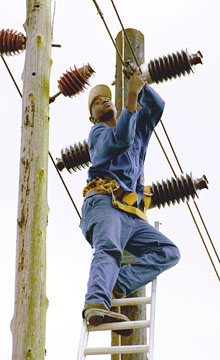
Repairing an electric power line in Mozambique. Photo: ©World
Bank / Eric Miller The 36-year-old businessman has produced beverages and food for local consumption since 1992. Two years ago Mr. Francis expanded his business to include canning tropical fruits to supply Africans living in the UK with local delicacies. His vision to better the economic welfare of fellow Ghanaians seemed within reach when his business grew to employ 20 people. Lately, workers come and go with the electricity. His best hope, he said, is purchasing a small power generator from abroad to compensate for the shortfall. Priced at about US$18,000, it is an investment few can afford. Blackouts are routine in almost all West African countries. The bulk of power plants and transmission facilities were built in the 1950s and 1960s. Little investment and maintenance has left the infrastructure creaking at the seams. Nigeria, a prime example, operates at one-third of its installed capacity due to aging equipment. During droughts, countries that depend on hydroelectricity ration power to relieve generators, transformers and cables -- such was the case with Ghana in the late 1990s. Wars have left equipment damaged and transmission lines cut. A large portion of Liberia's generation and distribution infrastructure was damaged or destroyed during its long civil war and the national electricity company estimates it will cost more than $107 mn and take over five years to fully restore the system. Sierra Leone's Bumbuna hydroelectric project was nearly complete when civil war disrupted construction. "In this part of the world, when governments talk of infrastructural development, they are mostly thinking of building a road somewhere. Electricity is considered a luxury commodity," Mr. Francis stated, noting that while policymakers all seem to agree that energy is crucial to a viable economy, they seem unwilling to match that rhetoric with financial commitment. "Things are changing for the better, but at a painfully slow pace." Need to invest in infrastructure According to Africa's own development blueprint, the New Partnership for Africa's Development (NEPAD), infrastructure is a pressing priority. Roads, water facilities, airports, seaports, railways, telecommunications networks and energy systems provide the vital underpinnings of any prosperous economy. It is estimated that no more than 20 per cent, and in some countries as little as 5 per cent, of the population in Africa (excluding South Africa and Egypt) has direct access to electricity. This figure falls to 2 per cent in rural areas. Demand is expected to grow by about 5 per cent annually over the next 20 years. It is critical, experts say, for Africa to build facilities to provide power to those lacking it, especially in the rural areas where the majority of Africans live. "Infrastructural development is not merely about erecting giant structures, but providing vital services, such as power to increase commerce, business productivity and enhance the lives of poor families by giving them affordable energy for cooking, heating and lighting," Mr. Ini Urua, principal industrial engineer within the NEPAD Unit of the African Development Bank (ADB), told Africa Renewal. The proportion of people in Africa still depending
on inefficient traditional energy sources is higher
than in any other continent. The dominant fuel for
cooking or lighting in low-income African homes is
wood or other biomass such as dung and crop wastes.
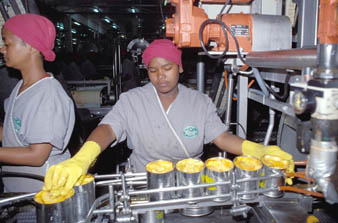
Kerosene is also widely used. African businesses
require affordable, reliable access to electricity.
Photo: ©iAfrika
Photos / Desmond Steward The direct burning of these types of material damages health and has been associated with respiratory diseases and eye problems. In addition, land degradation and deforestation continue to worsen as families cut down trees for desperately needed fuel. Women and children spend many hours in search of wood; electricity could free up their time for other activities. Electric lighting could also extend study hours for schoolchildren. Africa is endowed with resources vast enough to meet all its energy needs. Hydroelectricity is by far the single biggest source of electricity in a number of countries. The region possesses some of the largest water courses in the world -- the Nile, Congo, Niger, Volta and Zambezi river systems. The hydro potential of the Democratic Republic of Congo alone is estimated to be sufficient to provide three times as much power as Africa currently consumes. This potential remains largely untapped. Oil and gas reserves are concentrated in the north and west. By contrast, virtually all of Africa's coal reserves are in the south. Geothermal resources are largely in the Red Sea Valley and the Rift Valley. Much of Africa is well exposed to sunlight -- solar energy could be particularly useful in areas far from national grids. West African electricity Nigeria, Ghana and Côte d'Ivoire are the largest generators of electricity in West Africa. Nigeria's major sources of energy are petroleum, natural gas and hydroelectricity. Although the country exports electricity to neighbours, only a small portion of rural households in Nigeria are electrified. Ghana primarily relies on hydropower from its Akosombo Dam, on the Volta River about 80 kilometres upstream from the coast. Ghana supplies Benin and Togo with the majority of their electricity. In Côte d'Ivoire, thermal generating facilities powered primarily by oil and gas provide the majority of electricity. Countries connected to the Ivorian grid include Mali, Burkina Faso, Benin and Togo. The three landlocked and sparsely populated countries of Mali, Burkina Faso and Niger are not particularly well served with energy, mainly because they are relatively poor and are at least partially situated in the Sahara. Energy development is also very limited in the small coastal countries of Liberia, Sierra Leone, Guinea and Guinea-Bissau because of small economies and political strife. Power through integration Traditionally, energy planning has been undertaken on a national basis. But the cheapest energy source for a country might well lie just across the border. With cross-border energy networks, countries with surplus power could run their stations at optimum output without risking oversupply. Conversely, countries with limited generation capacity could access affordable power without building costly facilities. Power pooling also diversifies energy sources. In October 2000, 14 members of the Economic Community of West African States (ECOWAS) signed an agreement to launch a project to boost power supply in the region. Under the West African Power Pool (WAPP) agreement, countries hope to develop energy production facilities and interconnect their respective electricity grids. According to the agreement, the work would be approached in two phases. The first involves countries already interconnected, including Nigeria, Benin, Burkina Faso, Côte d'Ivoire, Ghana, Niger and Togo. The second phase involves countries not yet connected: Gambia, Guinea, Guinea-Bissau, Liberia, Mali, Senegal and Sierra Leone. Countries will work to harmonize the regulatory frameworks that govern their electricity sectors. ECOWAS estimates that 5,600 kilometres (km) of electricity lines connecting segments of national grids will be put in place. About $11.8 bn will be needed for the necessary power lines and new generating plants. This infrastructure would give the ECOWAS subregion an installed capacity of 10,000 megawatts (mw). "The pooling and sharing of energy resources would revolutionize the power sector in West Africa. Integrating power sytems would enable countries to have a reliable and affordable supply of electricity." -- Mr. Ini Urua, NEPAD Unit, African Development Bank "The pooling and sharing of energy resources would revolutionize the power sector in West Africa. Integrating power systems would enable countries to have a reliable and affordable supply of electricity," Mr. Urua said, noting that such regional integration embodies the NEPAD spirit. Projects galore The major sources of electricity under the power pool would be hydroelectricity and gas to fuel thermal stations. Hydropower would be mainly generated on the Niger (Nigeria), Volta (Ghana), Bafing (Mali), and Bandama (Côte d'Ivoire) rivers. In February 2003, the presidents of Ghana, Nigeria, Benin and Togo signed a treaty providing for a comprehensive legal, fiscal and regulatory framework to build a joint gas pipeline. The 620 km pipeline is set to run from Nigeria's Escravos oil field, where it will capture gas flared by Chevron, to Ghana. It will also provide gas to Benin and Togo and may eventually terminate as far west as Côte d'Ivoire and Senegal. Though the WAPP is still at an embryonic stage, ongoing joint projects between countries will further its goal to integrate the region. Nigeria and the African Development Bank (ADB) signed a $15.6 mn loan agreement in December 2002 to interconnect the Nigerian Electric Power Authority (NEPA) and the Compagnie Electrique du Benin (CEB) networks. CEB is the electricity transmission company for Benin and Togo. NEPA is planning a 330 kilovolt line from Nigeria to Benin as part of a larger West African integration also involving Niger and Togo. Work began in early 2003 on a project to connect portions of Niger to Nigeria's electricity grid. Under the project, three separate networks would be built at an estimated total cost of $16 mn. The imported power will be much cheaper than the domestically oil-generated electricity currently consumed. Ghana has plans to build an additional hydroelectric project on the Black Volta River. The $700 mn Bui project would have a generation capacity of 400 mw. In addition to increasing the domestic electricity supply, power generated from Bui could be exported to Burkina Faso, Mali and Côte d'Ivoire. A second facility, located on the Pra River, would have a total generating capacity of 125 mw. Mali, Mauritania and Senegal completed construction of the Manantali Dam in 1997. The Manantali includes a 200 mw power station and a 1,300 km network of transmission lines to the capitals of Mali (Bamako), Mauritania (Nouakchott) and Senegal (Dakar). Cost overruns, coupled with political tensions between Mauritania and Senegal, initially stalled construction. Manantali's generating facilities came online in December 2001, supplying power to Mali's grid. Senegal connected its power grid to Manantali in July 2002 and Mauritania in November of that year. The energy ministers of Togo and Benin agreed in
February 2004 to enhance cooperation in building a
hydroelectric plant at Adjaralla, on the southern
Togo-Benin border. In the late 1990s, both countries
were plunged into crippling power shortages when Ghana,
their main source of electricity, was forced to cut
supply by 50 per cent owing to a severe drought that
affected the Akosombo hydroelectric facilities. Only 2 per
cent of Africa's rural people are connected to national
power grids.
Photo: ©Panos
/ Guy Mansfield Growing demands for power have prompted Burkina Faso to seek to import electricity from neighbouring Côte d'Ivoire. A power line connecting the city of Ferkessedougou in northern Côte d'Ivoire with the Burkinabè capital, Ouagadougou, is expected to begin operations in 2005. Burkina Faso employs diesel generators to produce electricity, but high production costs prompted the government to begin interconnecting its grid with those of Ghana and Côte d'Ivoire to import additional electricity requirements. Major challenges Rural electrification raises a number of issues for African governments. Many rural communities have low population densities and are situated in remote locations. Connecting them to a national grid can be costly and often impractical. Alternatives include wind power, solar power and small diesel or petrol generators. ECOWAS has drawn up a regional programme to use renewable energy sources -- mainly solar energy, biomass, mini- and micro-hydroelectric projects and energy conservation. All these plans call for massive capital investment, both local and foreign. Most governments cannot come up with the necessary funding on their own. Experts agree that private capital is needed. The private involvement, however, raises public concerns that even if electricity works at the flick of a switch, consumers and businesses may not be able to afford service at a rate viable enough for profit-driven companies to recoup full costs. More than 40 per cent of Africa's 600 million people live below the internationally recognized poverty line of $1 a day. Assistance from donor governments is critical. Some donors willing to finance ECOWAS's WAPP project include the Agence Française de Développement, World Bank, European Investment Bank, West African Development Bank and the Nordic Fund. Back on the outskirts of Accra, Cyril Francis confesses that it can be hard to live on hope alone. He has heard something about the criss-crossing of power lines in West Africa, but has not stayed up late at night wondering how many kilometres have been covered. "I am cautiously optimistic," Mr. Francis muses. "Here in Africa you hear many things and nothing happens. We are waiting to see what happens."  [ Volume18 #4 Table of Contents ] [ Africa Renewal home ] [ New Releases ] [ Magazine - Current/Past issues ] [ Index / Search ] [ About us ] [ UN Home ] [ UN News ] [ NEPAD / UN Key Reports ] [ UN Africa Links ] Material from this article may be freely reproduced,
with attribution to Africa Renewal Tel: (212) 963-6857 Website: www.un.org/AR |