What to use when the oil runs outBy Alex Kirby, BBC News Online environment correspondent Last Updated:
Thursday, 22 April, 2004, 22:57 GMT
23:57 UK
This one substance has given us food, warmth, chemicals, medicines, clothing - and above all mobility. So it is natural enough for us to look for one neat and simple replacement which will be the perfect substitute for oil in all its versatile guises. But the harsh truth is that nothing is going to be capable of doing everything that oil does - not yet, perhaps never. Saved for essentials So planning for the fast-approaching end of the age of oil means accepting we shall have to rely on many partial solutions rather than one big one. It means accepting that there are some things which only oil can do, and making a priority list of essential purposes. Drugs and farming would probably come near the top. Next come the various other ways of producing energy, most of them classed as renewable in the sense that they rely on inexhaustible natural resources.
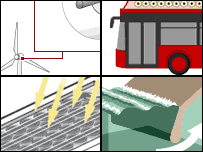
It is non-polluting, but works only where there is available water: building dams is seldom sustainable. Wave and tidal power are newer variations which will work in countries with coastlines; both have a lot of development ahead of them. Hydrogen is often seen as the fuel of the future, and one day it may be. It is virtually limitless, as it is a constituent of water, and is non-polluting. But it is hard to store and transport, and at the moment takes a lot of electricity to make, either from water or from fossil fuels. Its day may come when cheap electricity is available from solar power. Even in cloudy countries like the UK, photovoltaic cells can provide "a power station on your roof". Invaluable supplements But they cannot provide an uninterruptible supply, so will always need some back-up, perhaps in the form of batteries. In 10 years' time PVs will probably be competitive on cost with conventional energy. Wind power: turbines, the modern version of the windmill, can provide useful amounts of energy in countries with vigorous winds, like the UK.
They, like solar power, will not produce a round-the-clock supply, and often arouse local opposition because of their noise, appearance, and threat to birds. Biomass includes specially-grown crops like willow, and material like bagasse, sugar-cane waste, which power stations can burn. One UK station burns chicken droppings and the remains of cattle killed during the scare over BSE. In developing countries scarce wood is burnt, and also animal dung needed for fertilising the exhausted soil. Long-term options Geothermal energy uses the heat in the Earth's core, either from rocks and water near the surface or through drilling deep wells. It heats most buildings in Iceland, and is widely used in several other countries. Ocean energy can generate electricity by using the temperature difference between deep ocean water and surface water which has been warmed by the Sun. One estimate says less than 0.1% of the oceans' solar energy would supply more than 20 times the daily energy consumption of the US. But using this technology lies a long way ahead.
Nuclear power can deliver energy without adding to greenhouse emissions in the process, but it has several severe handicaps. Many people oppose it because they believe it is dangerous, and there is so far no way to dispose safely of nuclear waste. Mobility conundrum There is also what is called "the fifth fuel" - energy conservation, using energy sparingly. Leaving TVs on standby, overfilling kettles, forgetting to turn lights off, and unnecessary journeys all waste substantial amounts of energy. Allied to this is energy efficiency, squeezing all the potential out of every unit of energy, as in combined heat and power schemes. Many of these oil substitutes are available now. Most of the rest soon will be, and at an increasingly attractive price. The big conundrum is transport, because many of the replacement fuels do not lend themselves easily to use in vehicles. That apart, all it needs is for us to realise how
much we shall soon need to turn to these alternatives just to keep
the lights on.
|


 Alternative
approaches
Alternative
approaches


 At-a-glance