|
Last Updated: Friday, 25 February, 2005, 10:12 GMTGermany split over green energyGermany's ambitious plan to phase out nuclear power by 2020 while also reducing its reliance on fossil fuels has made it a leader in efforts to fulfil the Kyoto protocol.
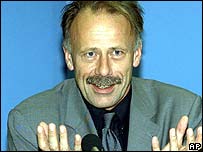
But critics are now predicting an energy crisis. Germany's government is hoping that abandoning its reliance on coal - which currently accounts for around half of the country's power needs - will cut carbon dioxide emissions by 40% compared with 1990 levels, well below what is required in Kyoto. But the country is also, crucially, abandoning its nuclear programme - planning to phase reactors out completely by 2020. Some in the industry - including advocates of renewable energy - have called this a "contradiction". "It is a fact that nuclear plants work without CO2 emissions," Petra Ullman, of energy company Eon - which runs a number of nuclear power stations - told BBC World Service's One Planet programme. "In a year, in Germany we save 170 million tonnes of CO2 by using nuclear power plants. If we shut down the nuclear power plants, the only alternative is coal." Radical proposalsThe architect of Germany's radical energy strategy is the government's Environment Minister, Juergen Trittin. He has already outlined the proposals to the EU. "We are on a strategy to phase out nuclear, to raise the share of renewables, and to increase the efficiency of fossil power plants," he said.
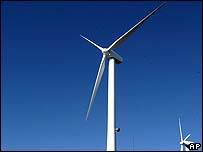
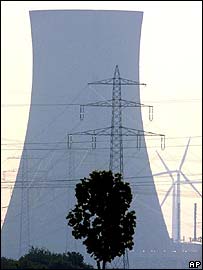
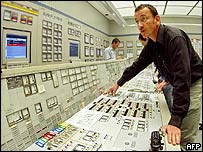
"We understand that this makes it possible that in the year 2020, when we have phased out nuclear, we will have been able to reduce greenhouse emissions by 40% compared with 1990." Under the current legislation, each of Germany's 19 reactors will be phased out on its 32nd birthday - at which point it is closed. The first one - the Stade nuclear reactor near Hamburg - has already shut and is awaiting decommissioning. To replace the energy demands, the government is proposing to boost its already considerable investment in wind power. Germany already produces 40% of all the world's wind power, and the hope is that by 2010, wind will meet 12.5% of German energy needs. The country has 16,000 wind turbines, mostly concentrated in the north of the country, near the border with Denmark - including the biggest in the world, owned by the Repower company. It is called the 5M - short for 5 megawatts - has a 126m diameter, and the one turbine has the ability to power 4,500 households. Repower hopes it is a prototype for offshore farms. Postponement callHowever, Dr Fritz Vahrenholt, Repower's chairman, has called for a postponement of the nuclear closure programme. "It is not very prudent to close the actual nuclear power plants we have," he told One Planet.
"Thirty-three percent of the electricity produced is nuclear. "My proposal is to postpone the phasing out of nuclear power plants for five or eight years - which gives us the opportunity to develop really competitive renewable energy." He also said there was "majority" support for this proposal amongst ordinary Germans, arguing that "I think there is an awareness that we cannot afford such a stark decrease in nuclear power." And he believes every government will have to face the problem of rising electricity costs. "If you stick to this plan of shutting a nuclear plant every year, the only result is more imports," he said. Cost concernsProfessor Wolfgang Pfaffenberger of the Bremen Energy Institute is skeptical about the potential for wind power. "The specific problem is that you cannot always have the wind when you need the energy," he argued. "That's why at the moment more than 15% of our capacity is wind power - but it produces only 3% of our energy. "So we have to build up an enormous over-capacity - which adds to our cost."
Dr Pfaffenberger points out that an average kilowatt from wind costs 10 cents, whereas the average cost of electricity on the market is only about one-third of this. He conceded there is potential to expand use of natural gas - but this is risky as Russia would be the main supplier, and could dictate the price. However Mr Trittin dismissed these concerns. "Ten years ago people told us that there would never be enough capacity to have a relevant share produced by wind - now the same people tell me we have too much wind, and have to export electricity because we have such a huge share of wind energy," he stated. "So I can't take these arguments seriously." He stressed he was "convinced" Germany would reach its target. And he dismissed Dr Pfaffenberger's concerns about cost out of hand. "He is wrong - simple," he said. "To hear such arguments from people who haven't learned anything in the last half century - I am very calm on that." |
||||||||