National Energy Grid
|
 |
|
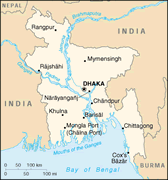
Full Size Map National Electricity Transmission Grid of Bangladesh(21 kb) |
GRID SUMMARY
Bangladesh has small reserves of oil and coal, but potentially very large natural gas resources. Commercial energy consumption is around 71% natural gas, with the remainder almost entirely oil (plus limited amounts of hydropower and coal). Only around 18% of the population (25% in urban areas and 10% in rural areas) has access to electricity, and per capita commercial energy consumption is among the lowest in the world. Noncommercial energy sources, such as wood, animal wastes, and crop residues, are estimated to account for over half of the country's energy consumption. Consumption of wood for fuel has contributed to deforestation and other environmental problems in Bangladesh.
Bangladesh's installed electric generating capacity in 2000 was 3.8 gigawatts (GW), of which 94% was thermal (mainly natural-gas-fired), and the remainder hydroelectric, at 18 power stations. With only around 18% of the population connected to the electricity grid, and with power demand growing rapidly (10% annually from 1974-1994; 7% annually from 1995-1997), Bangladesh's Power System Master Plan (PSMP) projects a required doubling of electric generating capacity by 2010.
The Padma-Jamuna-Meghna river system divides Bangladesh into two zones, East and West. The East contains nearly all of the country's electric generating capacity, while the West, with almost no natural resources, must import power from the East. Electricity interconnection from the East to the West was accomplished in 1982 by a new, 230-kilovolt (kV) power transmission line. The vast majority of Bangladesh's electricity consumption takes place in the East, with the entire region west of the Jamuna River accounting for only 22% of the total. Greater Dhaka alone consumes around half of Bangladeshi electricity.
Discussions have been underway for several years about the possibility of Bangladesh connection its electric grid to those of India, Nepal, and Bhutan. Nepal and Bhutan have substantial untapped hydroelectricity potential. This power could be consumed in those two countries and also exported to India, Pakistan, and Bangladesh. In March 1999, it was reported that India's Power Grid Corporation had completed a feasibility study on possible exchange of 150 MW of power between Bangladesh and India. Interconnection points would be Ishwardi, Bangladesh-Farakka, India and Shahjibazar, Bangladesh-Kurnarghat, India.