National Energy Grid
|
 |
|
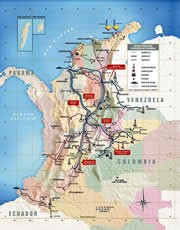
Full Size Map National Electricity Transmission Grid of Colombia(68 kb) |
GRID SUMMARY
Colombia possesses numerous fossil fuel and natural resources. The country has productive petroleum reserves, extensive coal reserves (the largest in South America), significant but largely untapped natural gas reserves, and extensive hydroelectric resources. A large amount of potentially productive oil and natural gas areas remain unexplored. Demand for energy (petroleum, natural gas, and electricity) is expected to grow 3.5% per year through 2020.
There are 11 companies in charge of electricity transmission in Colombia, the largest being the government-controlled Interconexión Eléctrica S.A. E.S.P. (ISA) which controls 83% of the electricity transmission market. ISA is the only energy transporter in Colombia with national coverage, and has one of the largest transmission networks in Latin America. ISA owns and operates 100% of the 500 kilovolt (kV) lines and substations in the STN, and 67.4% of the 230 kV transmission lines and 43.6% of the substations in the system. ISA's transmission network includes 4,500 miles of 230 kV and 500 kV lines and a 480-mile system on the Caribbean coast it acquired when it bought the state-owned utility Codelco in 1998. ISA also operates the National Dispatch Center (CND) and the Wholesale Energy Market (MEM).
One of the main transmission lines is the 500 kV San Carlos-Cerromastoso line, which connects the Atlantic coast to the national grid. Other important transmission lines include the Playas-Oriente and Guatapé-Envigado transmission lines, which connect those two power plants to the national grid. The transmission system has one interconnection with Ecuador and two with Venezuela. In 2001, Colombia signed an agreement with Ecuador to build another line connecting the two countries electricity networks; this 230 kV line will run from Pasto, Colombia, to Quito, Ecuador, and is expected to be operational sometime in 2003.
ISA has been very aggressive in expanding its transmission network and has invested more than $600 million to expand its transmission network since 1997. These investments included 560 kilometers of 230 kV lines that were incorporated into the network, 378 kilometers of 500 kV lines, and six 230 kV substations.