
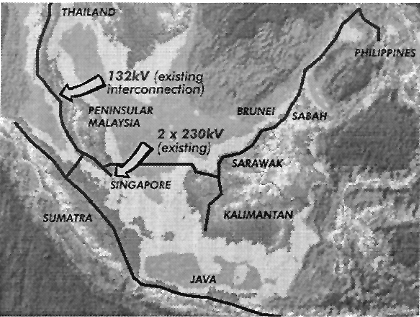
APREC (Asia Pacific Rim Electricity Cooperation)by: Gen-ichiro Ichihari 1. Expanding Electricity TradeIt is surprising for us living in the Islands of Japan to discover that electricity trade is expanding worldwide. Last year, our study mission on Asian energy visited countries where rapid economic growth exploded the demand for electricity beyond existing capacity. These countries were seeking Independent Power Producers or Electricity imports. This year's second mission visited countries with hydropower potential. We also witnessed clearly the emergence of electricity trade. For example, Electricite du Laos says, "We focus on electricity as a major export item, because it is hard to cultivate other industries with international competitiveness." Laos Ministry of Industry and Handicrafts says, "Electric power production contributes both foreign currency accumulation and domestic social progress." And, Malaysia Ministry of Energy, Telecommunications and Posts says, "Malaysia and Singapore interchange electricity at peak time." These comments awakened us to the spreading electricity trade. Although the present status of electricity trade is small, some governments signed a Memorandum of Understanding. Figure 1 illustrates the goals of the Memorandum to increase the electricity trade amount.In ASEAN, there is the Power Utility Forum. Within this forum, study groups plan the future ASEAN power system. Figure 2 shows interconnection of the ASEAN power system.
Source: Interviews
Figure 2 ASEAN Power System interconnection
On the other side of the world, European Union is already engaged in the trade of electricity. Figure 3 illustrates recent electricity export and consumption trends. EU urges central and eastern European nations to participate in projects called Trans-European Networks (TENs). There even exists a broader idea of Africa-Europe Electrical Interconnection: the Mediterranean Power Pool. Can we in Asia cooperate to establish cross-border electricity trade, to include not only ASEAN but also other countries, including Japan?
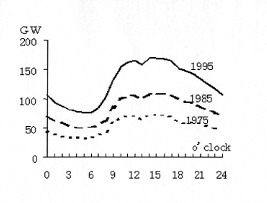
Source: United Nations "Energy Statistics Yearbook"(1995) 2. Global CooperationThe AC (Alternating Current) power transmission has a stability problem in long overhead transmission lines or under sea cables. Recent technical improvements in HVDC (High Voltage Direct Current) have tremendously extended the length of power transmission. It is technically feasible to keep power loss within 10 % for every 5,000km of transmission lines. Power supply increase is indispensable for economic growth: industrialization and informatization. Ironically however, required huge capital investment may deteriorate economic growth. Figure 4 and 5 show that load curve in Japan has the peak in the summer and midday. These tendency was observed in every country we visited. And the difference of demand between peak and off-peak is increasing with time. Figure 4 Yearly Load Curve in Japan (Peak in Months)
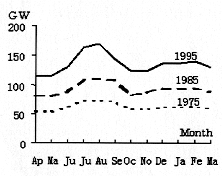
Source: Central load dispatching liaison office "Monthly summary report of generated and received power " Figure 5 Daily Load Curve in Japan (Peak Days)
The annual Load Factor (= annual average power load / system peak load) in Japan is only 55 %. It is not efficient for each county to prepare supply capability for the peak demand. If east and west countries with time difference or north and south hemisphere with season difference would share electricity, they would need lesser facilities to supply stable power. That is the reason to suggest this global vision: Asia Pacific Rim Electricity Cooperation (Figure 6).
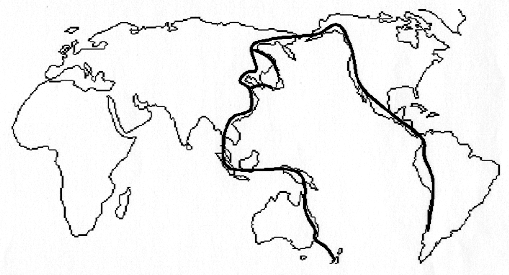
3. Global AllianceRecent progress towards privatization and deregulation of the power supply business enable the following vision feasible. That is public and private sector cooperation in development of an electricity network. Multi-national cooperation harmonizes energy balance by generating large power in appropriate locations for environmental protection, economy and energy security, and transmitting electricity in HVDC suitable for long distance. Renewal of obsolete transmission lines would decrease power loss and reduce frequent blackout. Moreover, "freedoms of location" and "scale merit" of power facilities will help to improve economic efficiency to be eligible for international finance. It is not necessary to construct the whole system at once, but begin stepwise operation from the appropriate sector. To avoid local optimization, it is desirable to have a global vision in advance and make progress step by step. Generally, it is very difficult for a nation to be domestically self-sufficient in energy. The energy import ratio over consumption is more than 80 % in Japan and over 60% in Thailand, as shown in Figure 7. They are mainly dependent upon Gulf oil, which implies many risks such as 1) conjunction in Strait of Malacca, 2) tanker accident, 3) sea lane security or 4) oil shock. As for energy import countries, electricity trade would diversify the energy source and contribute stable supply. On the other hand, energy producing countries can add value by changing export item from raw fuel to electricity, which is favorable for employment and stable foreign income. The countries, through which transmission line pass can also earn foreign money by assessing a transmit fee. So every country involved can benefit economically. The interchange of electricity means the sharing of critical lifelines within nations, whose economic interdependence contributes to international political security. This would be a wise choice in the post cold war era. Figure 7 Energy Balance
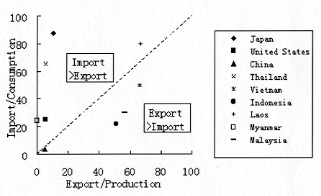
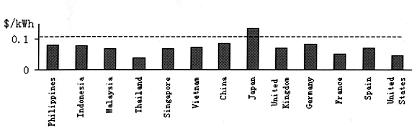
Source: United Nations "Energy Statistics Yearbook" (1995) Expensive electricity tariffs are apt to deteriorate manufacturers' competitiveness. Low tariffs may seem good for social welfare and manufacturers, but bad for energy save conscious and reinvestment of facilities. Electricity trade would contribute to the formulation of appropriate international price (see Figure 8). Figure 8 International comparison of Electric Tariff for Industry
|

|
|
|
|
|
| Asia |
4,225,479
|
699,636
|
16.6
|
| China |
1,923,304
|
198,700
|
10.3
|
| Lao |
210,000
|
3,037
|
1.4
|
| Myanmar |
160,000
|
1,450
|
0.9
|
| Japan |
129,840
|
91,654
|
70.6
|
| Cambodia |
83,000
|
0
|
0.0
|
| CIS & Russia |
2,105,600
|
323,760
|
15.4
|
| North America |
1,007,713
|
601,791
|
59.7
|
| South & central America |
3,933,770
|
550,658
|
14.0
|
| Peru |
1,091,540
|
12,615
|
1.2
|
| Europe |
1,158,029
|
486,819
|
42.0
|
| Africa |
1,590,828
|
64,043
|
4.0
|
| Oceania |
206,366
|
42,637
|
20.7
|
| World total |
14,227,785
|
2,769,344
|
19.5
|
Source: International Water Power & Dam Construction Yearbook (1997)
5. International Cooperation
To pursue this kind of vision, the most important thing is international cooperation. With the leadership of international organization such as APEC and ADB, with all might and main of governments and private companies and non profit organizations, we can realize this trans-border power network, a favorable step towards global ecology.
As for technology, it is important to cooperate with electric power companies, which have accumulated software and network operation expertise. Power generation equipment manufacturers can also support this new infrastructure with high quality hardware.
As for finance, there are many high risks with long term construction, operation and multinational coverage. To hedge these risks, project finance schemes, international financial organizations and government assurance is very important. Japanese cooperation through ODA (Official Development Assistance) should play a significant role for development in Asia and national security.
Asian nations used to achieve high economic growth,
but now they have suffered due to a financial crisis.
Further, the prolonged slowdown of the Japanese
economy threatens to become increasingly serious.
To escape from this stagnation, the Asia Pacific
rim can pull the world economy like a locomotive,
an important role in the 21st century that can be
realized by the APREC vision.