New battery packs powerful punchJuly 5, 2007 - Paul Davidson - USA TODAY
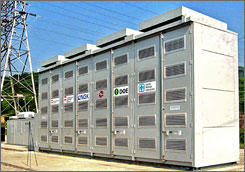
Batteries have long been vital to laptops and cellphones. They are increasingly supplying electricity to an unlikely recipient: the power grid itself. Until recently, large amounts of electricity could not be efficiently stored. Thus, when you turn on the living-room light, power is instantly drawn from a generator. A new type of a room-size battery, however, may be poised to store energy for the nation's vast electric grid almost as easily as a reservoir stockpiles water, transforming the way power is delivered to homes and businesses. Compared with other utility-scale batteries plagued by limited life spans or unwieldy bulk, the sodium-sulfur battery is compact, long-lasting and efficient. Using so-called NaS batteries, utilities could defer for years, and possibly even avoid, construction of new transmission lines, substations and power plants, says analyst Stow Walker of Cambridge Energy Research Associates. They make wind power — wildly popular but frustratingly intermittent — a more reliable resource. And they provide backup power in case of outages, such as the one that hit New York City last week. Such benefits are critical, because power demand is projected to soar 50% by 2030 and other methods of expanding the power supply are facing growing obstacles. Congress is likely to cap carbon dioxide emissions by traditional power plants to curtail global warming. Meanwhile, communities are fighting plans for thousands of miles of high-voltage transmission lines needed to zap electricity across regions. A test case in West Virginia American Electric Power (AEP), one of the largest U.S. utilities, has been using a 1.2 megawatt NaS battery in Charleston, W.Va., the past year and plans to install one twice the size elsewhere in the state next year. Dozens of utilities are considering the battery, says Dan Mears, a consultant for NGK Insulators, the Japanese company that makes the devices. "If you've got these batteries distributed in the neighborhood, you have, in a sense, lots of little power plants," Walker says. "The difference between these and diesel generators is these batteries don't need fuel" and don't pollute. The NaS battery is the most advanced of several energy-storage technologies that utilities are testing. The oldest and most widespread form of energy storage in the USA, pumped hydroelectricity, collects water after it spins a turbine and uses a small amount of electricity to send it back and repeat the process. Lead-acid batteries — the same kind used in cars — were installed by Southern California Edison in 1988. But the batteries, though inexpensive, typically fill warehouse-size buildings and last about five years. That's because the acid that connects positive and negative electrodes corrodes components. An NaS battery, by contrast, uses a far more durable porcelain-like material to bridge the electrodes, giving it a life span of about 15 years, Mears says. It also takes up about a fifth of the space. Ford Motor pioneered the battery in the 1960s to power early-model electric cars; NGK and Tokyo Electric refined it for the power grid. Since the 1990s, Japanese businesses have installed enough NaS batteries to light the equivalent of about 155,000 homes, says Brad Roberts, head of the Electricity Storage Association. In the USA, AEP is using the 30-foot-wide by 15-foot-igh battery to supply 10% of the electricity needs of 2,600 customers in north Charleston, says Ali Nourai, AEP manager of distributed energy. The battery, which cost about $2.5 million, is charged by generators from the grid at night, when demand and prices are low, and discharged during the day when power usage peaks. By easing strains on the grid, especially on the hottest summer days, the battery lets AEP postpone by about seven years the roughly $10 million upgrade of a substation and reduce the chances of a blackout, Nourai says. After it upgrades the substation, AEP can move the battery to another location. "Our vision is to have (batteries) throughout our system," he says. Storing wealth from wind farms A more intriguing goal is to wring more energy out of the wind farms that are cropping up across the country. Wind typically blows hard at night when power demand is low, producing energy that cannot be used. When demand peaks midday, especially in the summer, wind is often sporadic or absent. NaS batteries could let AEP store wind-generated power at night for daytime use. Next year, AEP plans to install another NaS battery in West Virginia to provide backup power in case of an outage — the first such application of the technology, Nourai says. The battery would kick in automatically, so customers would see no disruption. Other utilities are planning or considering the technology. In Long Island, N.Y., a group of utilities plans this summer to install an NaS battery at a bus depot. The battery is charged at night, when power prices are low, and discharged during the day to pump natural gas into tanks to provide fuel for the buses, says Mike Saltzman of the New York Power Authority. That cuts electric costs for the bus company and eases stresses on the grid. Pacific Gas & Electric is leaning toward installing a much larger, 5-megawatt battery by 2009, enough to power about 4,000 homes, says PG&E's Jon Tremayne. The biggest drawback is price. The battery costs about $2,500 per kilowatt, about 10% more than a new coal-fired plant. That discourages independent wind farm developers from embracing the battery on fears it will drive the wholesale electricity prices they charge utilities above competing rates, says Christine Real de Azua, spokeswoman for the American Wind Energy Association. Mass production, however, is expected to drive prices down, Mears says. He predicts NaS batteries will start to become widespread within a decade. Meanwhile, other storage devices are gaining traction, too. A group of Iowa municipal utilities plans to use wind turbines to compress air during off-peak hours that will be stored in an underground cavern. The air would be released at peak periods to run turbines and generate power for about 200,000 homes. Another technology, the flywheel, has a massive cylinder that can spin for days after being started by a generator. The cylinder can then activate a turbine to supply electricity for a few seconds or minutes when it's needed, for instance, to head off an interruption to a computer center from a lightning strike. "We'd like to see storage ubiquitous," says Imre Gyuk, head of energy storage for the Department of Energy, which helped fund the AEP project. "Stick it any place you can stick it."
|