|
|
|
|

Switching from Coal to Natural
Gas Would Do Little for Global Climate, Study Indicates
Sept. 8, 2011 - sciencedaily.com
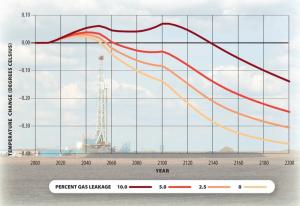 | | Shifting from coal to natural gas would have limited impacts on climate, new research indicates. If methane leaks from natural gas operations could be kept to 2.5 percent or less, the increase in global temperatures would be reduced by about 0.1 degree Celsius by 2100. The reduction in global temperatures would be more minor with higher methane leakage rates. (Credit: Courtesy Springer, modified by UCAR) |
ScienceDaily (Sep. 8, 2011) — Although
the burning of natural gas emits far less carbon
dioxide than coal, a new study concludes that a
greater reliance on natural gas would fail to significantly
slow down climate change.
The study by Tom Wigley, who is a senior research
associate at the National Center for Atmospheric
Research (NCAR), underscores the complex and sometimes
conflicting ways in which fossil fuel burning affects
Earth's climate. While coal use causes warming
through emission of heat-trapping carbon dioxide,
it also releases comparatively large amounts of
sulfates and other particles that, although detrimental
to the environment, cool the planet by blocking
incoming sunlight.
The situation is further complicated by uncertainty
over the amount of methane that leaks from natural
gas operations. Methane is an especially potent
greenhouse gas.
Wigley's computer simulations indicate that a worldwide,
partial shift from coal to natural gas would slightly
accelerate climate change through at least 2050,
even if no methane leaked from natural gas operations,
and through as late as 2140 if there were substantial
leaks. After that, the greater reliance on natural
gas would begin to slow down the increase in global
average temperature, but only by a few tenths of
a degree.
"
Relying more on natural gas would reduce emissions
of carbon dioxide, but it would do little to help
solve the climate problem," says Wigley, who
is also an adjunct professor at the University
of Adelaide in Australia. "It would be many
decades before it would slow down global warming
at all, and even then it would just be making a
difference around the edges."
The study will appear next month in the peer-reviewed
journal Climatic Change Letters.
A small impact on temperatures
The burning of coal releases more carbon dioxide
than other fossil fuels, as well as comparatively
high levels of other pollutants, including sulfur
dioxide, nitrogen oxides, and particles such as
ash. Since natural gas emits lower levels of these
pollutants, some energy experts have proposed greater
reliance on that fuel source as a way to slow down
global warming and reduce the impacts of energy
use on the environment.
But the effects of natural gas on climate change
have been difficult to calculate. Recent studies
have come to conflicting conclusions about whether
a shift to natural gas would significantly slow
the rate of climate change, in part because of
uncertainty about the extent of methane leaks.
Wigley's new study attempts to take a more comprehensive
look at the issue by incorporating the cooling
effects of sulfur particles associated with coal
burning and by analyzing the complex climatic influences
of methane, which affects other atmospheric gases
such as ozone and water vapor.
By running a series of computer simulations, Wigley
found that a 50 percent reduction in coal and a
corresponding increase in natural gas use would
lead to a slight increase in worldwide warming
for the next 40 years of about 0.1 degree Fahrenheit
(less than 0.1 degree Celsius). The reliance on
natural gas could then gradually reduce the rate
of global warming, but temperatures would drop
by only a small amount compared to the 5.4 degrees
F (3 degrees C) of warming projected by 2100 under
current energy trends.
If the rate of methane leaks from natural gas could
be held to around 2 percent, for example, the study
indicates that warming would be reduced by less
than 0.2 degrees F (about 0.1 degree C) by 2100.
The reduction in warming would be more pronounced
in a hypothetical scenario of zero leaks, which
would result in a reduction of warming by 2100
of about 0.2-0.3 degrees F (0.1-0.2 degrees C).
But in a high leakage rate scenario of 10 percent,
global warming would not be reduced until 2140.
"
Whatever the methane leakage rate, you can't get
away from the additional warming that will occur
initially because, by not burning coal, you're
not having the cooling effect of sulfates and other
particles," Wigley says. "This particle
effect is a double-edged sword because reducing
them is a good thing in terms of lessening air
pollution and acid rain. But the paradox is when
we clean up these particles, it slows down efforts
to reduce global warming."
In each of the leakage scenarios, the relative
cooling impact of natural gas would continue beyond
2100, continuing to offset global warming by several
tenths of a degree.
The study also found that methane leaks would need
to be held to 2 percent or less in order for natural
gas to have less of a climatic impact than coal
due to the life cycle of methane. Both coal mining
operations and the use of natural gas release varying
amounts of methane, but the escaping gas's influence
on climate also depends on emissions of other gases,
such as carbon monoxide and nitrous oxides, that
affect the amount of time methane remains in the
atmosphere.
A range of possible methane leaks
To compare the impacts of natural gas and coal,
Wigley drew on a number of studies that have evaluated
emissions of sulfur dioxide and other pollutants
from coal, as well as methane associated with the
use of both fuels. Rather than try to assign a
fixed percentage to methane leaks from natural
gas operations, which can vary widely and are difficult
to measure, Wigley analyzed the impacts of leakage
rates from 0 to 10 percent -- a broad range that
encompasses existing estimates.
To project future energy demand, Wigley used a
midrange estimate by the U.S. Climate Change Science
Program that assumed no changes in government energy
policies. He also assumed that sulfur dioxide emissions
from coal would drop sharply over the next few
decades due to pollution control devices.
Wigley then analyzed the impacts of a 50 percent
reduction in coal burning by using a simplified
computer climate model known as MAGICC (Model for
the Assessment of Greenhouse-gas Induced Climate
Change). The software, which Wigley helped develop,
simulates changes in atmospheric levels of greenhouse
gases and their influences on global climate.

|
|
|
|
|
|
|