|
|
|
|

Renewable Power Trumps Fossils
for First Time as UN Talks Stall
Nov. 25, 2011 - Alex Morales - bloomberg.com
 | | Blades for Vestas Wind Systems A/S wind turbines are stored at the company's factory in Tianjin, China. The findings indicate the world is shifting toward consuming more renewable energy even without a global agreement on limiting greenhouse gases. Photographer: Nelson Ching/Bloomberg |
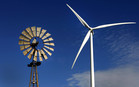 |
| A Vestas Wind Systems A/S turbine stands next to an old windmill
at the Sacramento Municipal Utility District Wind Power Plant in Rio
Vista, California. The renewables boom, spurred by about $66 billion
of subsidies last year, intensified competition between wind-turbine
and solar-panel manufacturers. Photographer: Ken |
Renewable energy is surpassing fossil fuels for
the first time in new power-plant investments,
shaking off setbacks from the financial crisis
and an impasse at the United Nations global warming
talks.
Electricity from the wind, sun, waves and biomass
drew $187 billion last year compared with $157
billion for natural gas, oil and coal, according
to calculations by Bloomberg New Energy Finance
using the latest data. Accelerating installations
of solar- and wind-power plants led to lower equipment
prices, making clean energy more competitive with
coal.
“
The progress of renewables has been nothing short
of remarkable,” United Nations Environment
Program Executive Secretary Achim Steiner said
in an interview. “You have record investment
in the midst of an economic and financial crisis.”
The findings indicate the world is shifting toward
consuming more renewable energy even without a
global agreement on limiting greenhouse
gases.
Delegates from more than 190 nations converge in
Durban, South Africa, on Nov. 28 to discuss new
measures for limiting emissions damaging the climate.
Subsidizing the Boom
The renewables boom, spurred by about $66 billion
of subsidies last year, intensified competition
between wind- turbine and solar-panel manufacturers,
gutting margins from the biggest producers led
by Vestas
Wind Systems A/S and First
Solar Inc. (FSLR) The 95-member WilderHill
New Energy Index (NEX) of renewable- energy stocks has tumbled 40
percent this year, steeper than the 14 percent
drop in the MSCI World Index.
The zeal to replace fossil fuels, which take millions
of years to form from dead organic matter, belies
the failed efforts at the UN talks to broker a
deal that would limit carbon dioxide emissions
from coal and oil blamed for global warming. Without
a deal, existing pollution caps under the 1997
Kyoto Protocol expire next year.
Debate in South
Africa’s third-largest city
will include how to establish a fund that would
channel an unspecified portion of $100 billion
a year in climate aid pledged by rich nations to
developing countries by 2020. Monitoring and verifying
emissions cuts made by all nations are also on
the agenda, as well as making a mechanism for transferring
CO2- reducing technology between states. Discussions
on those issues may be eclipsed by talks on the
future of Kyoto.
‘
Paralyzed’
“
It’s impossible to punt any further down
the line a decision regarding a second commitment
period for the Kyoto Protocol,” Harvard University
Environmental Economics Director Robert Stavins
said in an interview. “Those discussions
will dominate, and the process could become paralyzed.”
The talks on the future of Kyoto were deadlocked
after existing members Russia, Canada and Japan said they won’t make new emissions targets
after 2012 because the accord doesn’t set
limits for the three biggest polluters: the U.S.,
which never ratified it, and developing nations
China and India.
“
Hopes have been ratcheted down,” said Daniel
Yergin, chairman of IHS Cambridge Energy Research
Associates. “The notion that there is going
to be a global compact on this have been pushed
back,” said the author of “The
Prize,” a
history of the oil industry that won him a Pulitzer
Prize in 1992.
‘
Bewildering’ Rules
The wind-energy industry is now more focused on
the “sometimes bewildering variety of domestic
and regional policies” than on the UN negotiations
as a source of impetus for growth, said Steve Sawyer,
secretary-general of the Brussels-based Global
Wind Energy Council.
As well as renewables spending exceeding that on
new fossil plants, last year also was the first
time expenditure in developing
countries, mainly
China, exceeded that in the industrialized world,
Sawyer said, predicting both trends will continue.
The New Energy Finance figures exclude investment
that merely replaces existing plants, and its renewables
tally excludes money spent on building large hydropower
projects.
Wind operators are likely to install 43 gigawatts
of generating capacity this year and 48 gigawatts
next year, up from 36 gigawatts in 2010, GWEC estimates.
New Energy Finance forecast solar installations
globally to total 26.4 gigawatts in 2011 and 27.8
gigawatts in 2012, up from 18.2 gigawatts last
year. Investment in renewable energy may double
to $395 billion a year by 2020, led by growth in
offshore wind and solar projects, the London-based
analyst said Nov. 16.
Struggling Industry
Even with the boom, renewables companies are struggling.
Growing demand for wind
turbines and solar panels
led to a surge in production. The resulting overcapacity
forced companies from Chinese solar manufacturers
Yingli
Green Energy Holding (YGE) Co. and Renesola
Ltd. (SOLA) to U.S. rivals SunPower
Corp. (SPWRA) and First Solar along with Vestas of Denmark to
slash forecasts for margins and sales this year.
Recession in European nations has also held back
demand.
“
In some countries the actual energy consumption
has gone down because of the financial crisis,
and that means it’s even more difficult to
develop new projects,” said Ditlev
Engel,
chief executive officer of Vestas, which is the
world’s biggest wind turbine maker.
Royal
Dutch Shell Plc (RDSA) is among the companies
supporting CO2 trading under the climate talks
as a cheap way to encourage cleaner emissions,
said Graeme Sweeney, executive vice president for
CO2 at Shell, Europe’s biggest oil company.
Pollution Price
“
CO2 pricing that’s supported through carbon
markets delivers the lowest cost, the fastest,
and the most effective response to climate
change,” Sweeney
said. The company would like to see carbon capture
and storage, a technology that pumps power plant
emissions for permanent underground storage, included
in the UN’s Clean Development Mechanism carbon-offset
program, he said.
Financial austerity measures in 10 nations, including
the U.S., Japan, Spain and Germany, will cut spending
on climate- protection measures by $45 billion
in the five years through 2015, Ernst & Young
forecast on Nov. 17. The measures include renewable-energy
subsidies and tax credits and pollution- abatement
programs.
“
Governments of the leading countries of the world
are likely to drastically slow down their investments
in sustainability amid public spending cuts that
could escalate if the debt crisis worsens in Europe,” said
Juan Costa Climent, E&Y’s London-based
climate sustainability chief, a former Spanish
trade secretary. “In this context, reaching
an agreement in Durban seems impossible.”
Share of Demand
Renewable energy now accounts for a small proportion
of global demand, about 4 percent when counted
with biomass and generators powered by waste, according
to the International
Energy Agency. That level
will rise to 14 percent by 2035 under the Paris-based
organization’s central forecast. Oil, coal
and gas that today have 75 percent of demand will
see that figure drop to 62 percent over the same
period, the IEA says.
With an extension to Kyoto in its current form
unlikely, the 27-nation EU bloc will push for a
clear path charting when countries will make legally
binding commitments, EU Climate Commissioner Connie
Hedegaard said in an interview. The EU, which accounts
for 11 percent of global emissions, will seek to
reach a new, expanded treaty with the world’s
biggest emitters.
“
You cannot keep momentum in a political process
just by implementing old decisions,” Hedegaard
said. “A road map with a timetable would
mark one significant step forward.”
Envoys at last year’s climate talks in Cancun,
Mexico, set a goal to contain global warming to
2 degrees Celsius (3.6 Fahrenheit) since the 19th
century. Pledges made so far, which aren’t
legally binding, are insufficient, according to
the IEA.
2 Degree Limit
“
With current policies in place, global temperatures
are set to increase 6 degrees Celsius, which has
catastrophic implications,” IEA Chief Economist
Fatih
Birol said. “If as of 2017 there is
not a start of a major wave of new and clean investments,
the door to 2 degrees will be closed.”
The South African organizers want to ensure new
targets are set under Kyoto, which developing countries
value because it holds the developed world to account
for more than a century of climate-warming emissions.
“
We cannot from conference to conference repeat
the same rhetoric without getting to a practical
implementation,” Cedric Frolick, House Chair
in the South African Parliament, said in an interview. “We
simply cannot afford for Durban to become the graveyard
of the Kyoto
Protocol.”

|
|
|
|
|
|
|