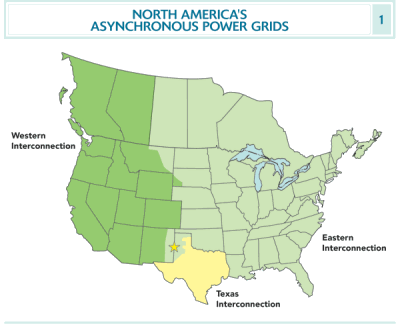
Tres Amigas Technology Holds Promise for Expanding Renewable Energy SupplyJun. 2, 2011 - Teresa Hansen - elp.comA few months ago, New Mexico Governor and former U.S. Energy Secretary Bill Richardson announced that his state will be home to an energy transmission project that will connect the three main U.S. power grids. The Tres Amigas SuperStation will allow energy to be shared among the Eastern Interconnection, Western Interconnection—known as the Western Electricity Coordinating Council (WECC)—and Texas Interconnection—known as the Electric Reliability Council of Texas (ERCOT). Tres Amigas LLC CEO Phil Harris developed the SuperStation concept and conducted its initial research and design. He is the former CEO of PJM Interconnection, the world’s largest transmission balancing area with more than 240,000 MW under management. “After I retired from PJM, I worked in China and Europe on high-voltage transmission projects,” Harris said. “I knew there was a lot of interest and need for a high-voltage interconnection in the United States, and I’m originally from New Mexico.”
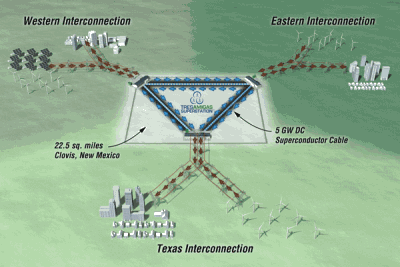
The project’s main goal is to create a first-of-its-kind market hub through which potential U.S. renewable energy can be developed and delivered to load centers. The project will be the proving ground for superconductor electricity pipeline technology. It also promises to increase the U.S. power grid’s reliability and security. Its strategic partners are American Superconductor, AltEnergy LLC and ZGlobal Inc. Several studies from the Western Governors’ Association, EPRI working groups and Department of Energy focused on the need for an interconnection have identified Texas and New Mexico as ideal locations because the three interconnections are closest to one another there. New Mexico wanted the project and agreed to a 99-year land lease, said Jack McCall, American Superconductor director of business development HTS T&D systems. “New Mexico had the space and allowed us to lease 22 square miles of land, or about 14,400 acres, near Clovis,” McCall said. The eastern New Mexico city is near the borders of Colorado, Oklahoma and Texas—states with a lot of wind and solar energy potential. Many wind and solar developers are interested in the project, Harris said. “The nation needs large renewables, and people want green power,” Harris said. “This facility will allow much of the nation’s wind energy to be harnessed and transported to areas where it’s needed. If this was an oil field find, it would be as big as Purdue Bay.” Clovis is also close to several major transmission projects. So far, five transmission companies—Public Service Co. of New Mexico, ITC, Excel Energy, American Electric Power and Sharyland Utilities—via letters of intent have committed to connecting to Tres Amigas, and more are in negotiations. The Transmission Bottleneck To understand how and why Tres Amigas is a groundbreaking project, one must know how electricity flows—or doesn’t flow—among North American power grids now. Each of the three grids can transfer electricity to another through a direct current (DC) converter link. Typically, alternating current (AC) power from transmission lines is converted in one grid to direct current (DC) as an intermediate power form at a substation. The power is then re-converted from DC back to AC before reaching the adjacent grid. This synchronizes power flows. This transfer can occur only between two grids. In other words, electricity can be transferred from one grid to another grid, but not among all three at the same time. Never have all three grids been united at one time. Currently 10 DC converter links exist in North America. Seven links connect the Eastern Interconnection and WECC grids in the U.S., and one connects the two in Canada. In addition, two links connect ERCOT to the Eastern Interconnection. No interconnection exists between ERCOT and the WECC. Most of the DC converter links carry 100-200 MW of electricity each. One of the two that connects ERCOT to the eastern grid is 600 MW, which is the largest exchange. The total capacity of all 10 is about 2.3 GW. Tres Amigas initially will be able to carry up to 5 GW of electricity at a time but will be scalable and can expand to 30 GW, Harris said. “Tres Amigas will be an open-access facility and will likely continue to grow for many years,” he said. “Construction will continue like in the space station. We will add voltage-sourced converters as more companies tie into the facility.” Tres Amigas Technology The Tres Amigas SuperStation will employ the latest power grid technologies, including three high-voltage DC (HVDC) terminals created from voltage source converters (VSCs). The HVDCs, each of which has a 5-GW capacity, will be placed about 2 miles apart in a triangle-shaped loop (see Figure 2). The terminals will be connected by an underground DC superconductor cable (pipeline) that can carry more than 5 GW of electricity with no electrical loss. Each HVDC terminal also will be equipped with an advanced battery system.
The VSCs used for the terminals are power electronics systems that allow multi-terminal access to and from DC lines and cables, McCall said. “There won’t be a single 5-gigawatt line coming into each terminal, but three to five lines coming into each one,” McCall said. “You don’t want all the transmission lines coming into one terminal; you want them to be spread apart.” Voltage converters are much more robust than old-technology DC links, Harris said. VSC technology is being used in more than a dozen locations around the world. Installed at the interconnection point of each of the three U.S. power grids, the VSC terminals will transition the AC power flowing from the powerlines feeding into the SuperStation into DC power and then will transition DC power into AC power at the adjacent grids. Harris said the project will be similar to a highway rotary used for traffic flow with the superconductor cables serving as the main pathway for electricity, and VSCs serving as on-ramps and off-ramps for the power. The DC superconductor cable technology that will provide the pathway for the electricity was developed within the past decade. The concept of using superconductor cable for DC power transmission originated with an EPRI report completed in 1997. The more general concept of using superconductor cable for long-distance, high-power transmission, however, dates back to at least 1967. The cable can carry gigawatts of power with 100 percent efficiency among the SuperStation’s three converter stations. The cable will be contained in a 3-foot underground pipeline similar to those used in the oil and natural gas industries. Superconductor cables are more power-dense and efficient than other transmission options. Their underground nature also significantly enhances system security and reliability, McCall said. “Overhead transmission lines could be used,” he said, “but it would take three to four overhead circuits to move what the underground pipeline can move. Also, overhead is less reliable and secure than underground, and traditional underground transmission would need eight to 10 DC lines, which would require a large right-of-way and would result in large power losses.” Because superconductor cable carries higher voltage, it has less voltage losses: zero, McCall said. “Superconductor pipeline was originally looked at for long-distance transmission due to its lack of line losses, easier siting requirements and right-of-way needs, as well as lower cost allocation based on the amount of electricity that can be moved,” McCall said. “It was also envisioned to have many terminals so that electricity input and off take could occur along the line.” Tres Amigas, which will use only a 6-mile loop and three terminals, is a different application than what was originally envisioned. Because it will be transporting such high-level DC power, however, the technology makes sense, McCall said. “Tres Amigas is exciting because it will develop and prove superconductor pipeline technology outside a lab,” McCall said. The technology has been proven in the lab and in numerous demonstration projects, but it is a “big leap of faith” for a transmission company or utility to invest in 1,000 miles of the technology without any history of it working in long-distance, high-voltage settings, McCall said. “Tres Amigas is the perfect project for the technology because it needs high-voltage transmission, but doesn’t need many miles of it,” he said. VSCs on a typical DC circuit mostly are limited, and higher voltages aren’t possible. The voltage can be increased, but the current also must be increased, resulting in higher losses. VSCs usually are used for lower-current or short distances. “Superconductor cables have allowed voltage source converters to come into their own,” McCall said. “Superconductor cable can transmit high voltages without increasing current, thus eliminating losses.” Because most of the megawatts entering the SuperStation will be generated with intermittent renewable energy sources, it must be able to handle numerous charge-discharge cycles. Tres Amigas, therefore, will be equipped with batteries to provide short-term energy storage, mainly to keep the system balanced, McCall said. “Tres Amigas will serve as its own balancing authority,” McCall said. “The electricity coming in must equal the electricity going out.” The battery storage also will allow Tres Amigas to store some electricity and resell it—an ancillary product of energy storage. It also will provide reactive system support, enhancing grid reliability and power quality. Tres Amigas developers have not selected the battery technology and supplier, but they are considering proven technologies and designs that will complement energy transfer while providing optional ancillary services. Right Technology, Right Market Tres Amigas developers are convinced that the technology and business environment are right for this project, Harris said. “There is a national interest in this project, and it addresses a national need,” Harris said. “It is in the nation’s best interest to build this facility.” The project will create one market out of three, said David Raskin, a partner at the Washington office of Steptoe & Johnson LLP and counsel for Tres Amigas. “It’s a market expander, and as such will create additional opportunities and investment incentives for renewable power,” Raskin said. It will incent development beyond just the renewable portfolio standards that are driving much of the current renewable energy development, he said. Tres Amigas appeals to generators and suppliers for a couple of reasons. First, if the marginal price at one side of the facility (in one of the three grids) is different than at the other side, suppliers or generators will be interested in selling into the other grid. Second, demand for renewables is increasing nationwide. Texas has a lot of wind power, but ERCOT is almost saturated with wind. The state can only develop its potential wind and solar power if it can move some of that power onto the other grids. New Mexico has a lot of potential solar power and wants to expand its market. Tres Amigas is in the perfect place to allow renewable energy to be moved to load centers where it can be used. Tres Amigas also will serve as an anchor to the nation’s transmission system, Raskin said, improving its reliability. The electrical engineering features of the VSCs will provide reactive power to the system, providing support to large transmission lines coming into the facility and making the grid more stable. “Without the VSC and pipeline superconductor technology, the facility would not be possible,” Raskin said. “This is an example of the right technology coming along at just the right time. The facility would not have been possible even three to five years ago.” The Business Model Tres Amigas differs from any transmission project ever built, but it is still a merchant transmission project and falls under Federal Energy Regulatory Commission (FERC) regulations, Raskin said. “Transmission is a highly regulated business and usually considered a monopoly,” Raskin said. In early December 2009, Raskin filed two FERC applications that must be approved for the $1 billion project to attract needed investors. One of those filings will determine how Tres Amigas can establish transmission rates and collect on those rates. “Unlike most transmission system owners, Tres Amigas will have no captive customers,” Raskin said. “The developers are taking a major market risk. In turn, they want pricing flexibility to charge what the market will bear. They must have the requested pricing approval to ensure they can make money and thus obtain financing.” FERC has two models for establishing and collecting transmission rates, Raskin said. One is a cost-based model that normally applies to transmission providers with captive customers that bear responsibility for transmission costs under an individual or regional open-access transmission tariff or other transmission arrangement. This is the typical model for a regulated investor-owned utility. The other is based on merchant transmission rate setting. In this model, a transmission company takes the market risk and can charge negotiated rates. Merchant transmission companies hold open auctions and sell capacity based on what the market will bear. The price depends on the difference between energy costs at the two ends of the line. For example, if electricity is selling for 10 cents a kWhr at one end of the line and 20 cents a kWhr at the other, then a company might be willing to pay 10 cents to send its power across the lines. “Tres Amigas is different than any merchant transmission company,” Raskin said. “Transmission companies are looking for customers to buy capacity under long-term contracts—20 to 30 years.” Tres Amigas needs more flexibility than a traditional merchant transmission company because it must offer short- and medium-term pricing. Because it’s a market hub, transactions must be offered based on market conditions at a particular time. These conditions can and will change, Raskin said. “If limited to long-term pricing, we may not have the flexibility necessary to make Tres Amigas economically successful,” he said. “We can’t rely on history to tell us what the market will be. I think FERC will recognize this as being a great opportunity to move renewable energy forward and open up power markets.” The second FERC application Raskin filed requests that the commission allow ERCOT to remain separate and independent from FERC regulations. “Tres Amigas is a market expander for ERCOT,” Raskin said. “But at the same time, Texas places great value on its independence from FERC. Even if the economic benefits are major, I would be very shocked if Texas would give up ERCOT’s independence. The separation of ERCOT from FERC control is a foundational aspect of electricity law in the United States. Tres Amigas should not change that. In addition, I don’t believe FERC has any interest in controlling ERCOT.” By law, FERC must rule on the Tres Amigas application within 60 days of the filing: Feb. 6, a Saturday, so the ruling likely will come Feb. 5. The ruling can be delayed if FERC comes back to Raskin with questions or a request for more information. Also in the next 60 days, opponents of the project can provide FERC with concerns and opinions, which could delay the ruling. That’s not too likely, Raskin said. “I currently don’t know of any constituency that would have reason to oppose the project,” he said. “Many are filing in support of it. “The industry’s reaction to Tres Amigas has been very favorable. It has truly been a unique outpouring of support. I’m hopeful and confident that FERC rules in our favor on both filings.” 
|