 A how-to guide to slashing California's greenhouse gas emissions by 2050Nov. 30, 2011 - energy-daily.com Such is a future envisaged in a study published by the journal Science that analyzes the infrastructure and technology changes needed to reach California's aggressive emissions reduction goal. The study was conducted by scientists from the U.S. Department of Energy's Lawrence Berkeley National Laboratory (Berkeley Lab) and the San Francisco-based energy consulting firm Energy and Environmental Economics (E3). The researchers describe a not-so distant time in which lights, appliances, and other devices are pushed to unprecedented levels of energy efficiency. Electricity is generated without emitting carbon dioxide into the atmosphere. And most importantly - even after these measures are implemented - cars, heating systems, and most other equipment that now run on oil and natural gas will instead be powered by electricity. The scientists say that all of this will be technologically feasible by 2050 if today's pace of technology innovation continues. "This study is meant to guide decisions about how to invest in our future. Assuming plausible technological advances, we find that it's possible for California to achieve deep greenhouse gas reductions by 2050," says Margaret Torn, the corresponding author of the paper and a staff scientist in Berkeley Lab's Earth Sciences Division. Jim Williams, chief scientist at E3 and professor at the Monterey Institute of International Studies, is the lead author of the paper. "To reach this goal, energy efficiency comes first, followed by decarbonization of electricity generation, followed by the electrification of transportation and other sectors," says Williams. The scientists developed this prescription using a model of California's greenhouse gas emissions from 2010 to 2050 that takes into account the state's changing population, economy, and physical infrastructure. The model includes six energy demand sectors (residential, commercial, industrial, agriculture, transportation, and petroleum industry) and two supply sectors (fuel and electricity). They explored the best ways to reach California's goal of reducing greenhouse gas emissions in 2050 by 80 percent below 1990 levels. This target is consistent with the Intergovernmental Panel on Climate Change's Fourth Assessment Report, which outlines the global emissions required to stabilize atmospheric concentrations at 450 parts per million. In California, this means a sharp reduction in CO2 emissions per year from 427 million metric tons in 1990 to 85 million metric tons in 2050. The scientists started with this 85 million metric ton target and worked backwards to determine the changes needed to get there. They arrived at four mitigation scenarios, all of which rely on three major energy system transformations. Among the findings: Energy Efficiency Comes First The catch, however, is that energy efficiency will have to improve by at least 1.3 percent per year over the next 40 years. This is less than the level California achieved during its 2000-2001 electricity crisis, but it has never been sustained for decades. The scientists found that the largest share of greenhouse gas reductions from energy efficiency comes from the building sector via improvements in building shell, HVAC systems, lighting, and appliances. Next, Decarbonize Electricity Generation Renewable energy, nuclear power, and fossil fuel-powered generation coupled with carbon capture and storage technology each has the potential to be the chief electricity resource in California. But they all must overcome technical limitations, and they're all currently more expensive than conventional power generation. Because it's unclear which technology or technologies will win out in the long run, the scientists developed three separate scenarios that emphasize how each can reach the target, plus a fourth scenario that includes a blend of all three. In addition, they determined that Californians can't rely on renewable energy alone. At most, they found that 74 percent of the state's electricity could be supplied by sources such as wind and solar. The scientists also stressed that a renewable energy-intensive grid will require breakthroughs in energy storage and ways to enable smart charging of vehicles, among other technologies. They also found that 15 percent of the required emissions reductions could come from measures to reduce non-energy related CO2 and other greenhouse gas emissions, such as from landfill and agricultural activities. And 14 percent could come from various unrelated technologies and practices such as smart planning of urban areas, biofuels for the trucking and airline industry, and rooftop solar photovoltaics. And Finally, Goodbye Gas, Hello Electrons They determined that most of these technologies had to be electrified, with electricity constituting 55 percent of end-use energy in 2050, compared to 15 percent today. Overall, this nets a 16-percent reduction in greenhouse gas emissions, the final push needed to achieve an 80-percent reduction below 1990 levels. The largest share of greenhouse gas reductions from electrification came from transportation. In the study, 70 percent of vehicle miles traveled - including almost all light-duty vehicle miles - are powered by electricity in 2050. "The task is daunting, but not impossible. California has the right emissions trajectory with Assembly Bill 32," says Williams, referring to California's 2006 emissions legislation. "And it isn't a matter of technology alone. R and D, investment, infrastructure planning, incentives for businesses, even behavior changes, all have to work in tandem. This requires policy, and society needs to be behind it." 
|
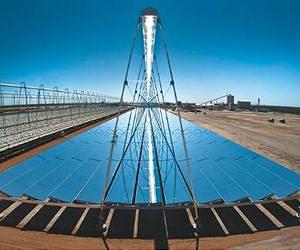 What will a day in the life of a Californian
be like in 40 years? If the state cuts its greenhouse
gas emissions 80 percent below 1990 levels by 2050
- a target mandated by a state executive order
- a person could wake up in a net-zero energy home,
commute to work in a battery-powered car, work
in an office with smart windows and solar panels,
then return home and plug in her car to a carbon-free
grid.
What will a day in the life of a Californian
be like in 40 years? If the state cuts its greenhouse
gas emissions 80 percent below 1990 levels by 2050
- a target mandated by a state executive order
- a person could wake up in a net-zero energy home,
commute to work in a battery-powered car, work
in an office with smart windows and solar panels,
then return home and plug in her car to a carbon-free
grid.