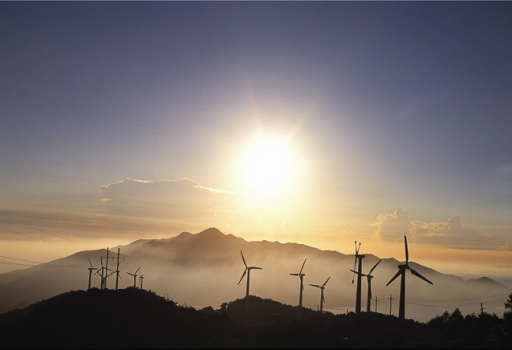
Worldwatch Report Looks at The Role of Renewables in China's FutureNov 16, 2007 - Jennifer Runyon - RenewableEnergyAccess.com
Symbolic though it may be, it cannot go unnoticed that China's richest man, according to the Forbes Magazine's 2006 annual list of billionaires, is the CEO of solar cell producer, SunTech Power Holdings. Even though virtually all of the company's product is exported, (coal provides most of China's energy) it's clear that the role renewable energy plays in China's future will continue to increase. This is all according to a new report, released on Thursday by the Worldwatch Institute that focuses on renewables in China's future. The 48-page comprehensive report, written by Eric Martinot and Li Junfeng concludes that China will likely achieve — and may even exceed — its target to obtain 15 percent of its energy from renewables by 2020. If China's commitment to diversify its energy supply and become a global leader in renewable energy technology manufacturing persists, renewable energy could provide over 30 percent of the nation's energy by 2050.
A summary of the report is excerpted below, with a link to the full report at the bottom of this page. China's need for secure, affordable, and environmentally sustainable energy for its 1.3 billion people is palpable. In 2006, China's energy use was already the second highest in the world, having nearly doubled in the last decade, and its electricity use is growing even faster, having doubled since 2000. With both energy-intensive industry and high-tech manufacturing, China now serves as factory to the world. Rising living standards also mean more domestic consumption, including high-energy-use items like air conditioners and cars. By 2020, annual vehicle sales in China are expected to exceed those in the United States. While most of China's electricity comes from coal and hydropower, the growing use of oil for China's burgeoning vehicle fleet is adding greatly to concerns about energy security. Already, China must import nearly half of its oil. Concerns about energy security, power capacity shortages, and air pollution are all adding urgency and pressure to switch to alternative technologies and fuels, including greater energy efficiency, "clean coal" technologies, nuclear power, and renewable energy. China has become a global leader in renewable energy. It is expected to invest more than $10 billion in new renewable energy capacity in 2007, second only to Germany. Most of this is for small hydropower, solar hot water, and wind power. A landmark renewable energy law, enacted in 2005, supports continued expansion of renewables as a national priority. China currently obtains 8 percent of its energy and 17 percent of its electricity from renewables-shares that are projected to increase to 15 percent and 21 percent by 2020. The report focuses on potential renewable energy uses in the country, looking in-depth at wind power, solar power, solar hot water and heating, and biomass power and biofuels. Lou Schwartz, President of China Strategies, LLC emphasizes that U.S. business leaders and government officials must pay attention. He says that not only does the report "vividly demonstrate several crucially important matters about China's commitment and capacity to spur the development of its renewable energy industry that government and business leaders in the United States cannot afford to ignore," but it also indicates that China's leadership "understands that there is a tremendous business opportunity in the development of what may be the world's next great industry." Schwartz is also author of the China Renewable Energy and Sustainable Development report featured each month on RenewableEnergyAccess.com. And the opportunity for development in the country is huge. More from the report is below: Total power capacity from renewables could reach 400 gigawatts by 2020, nearly triple the 135 gigawatts existing in 2006, with hydro, wind, biomass, and solar PV power making the greatest contributions. More than one-third of China's households could be using solar hot water by 2020 if current targets and policies are continued. Use of other renewables, including biogas and perhaps solar thermal power, will increase as well. Worldwatch Institute President, Christopher Flavin, drives home the impact China may have on the world. "How this story ends up may have as large an impact on the world's future as it does on China's. If China is able to scale up its renewable energy technologies to the levels needed to have an impact domestically, and if it is able to achieve the low prices needed to succeed in the local market (known in manufacturing circles as the "China price"), it may be virtually inevitable that these same technologies will soon be adopted on a massive scale around the globe." Flavin continues, "the future of the global climate may rest in large measure on China's ability to lead the world into the age of renewable energy, much as the United States led the world into the age of oil roughly a century ago." The fact of the matter is this: there is significant renewable energy potential in China and the time to do something about it is now. Says Schwatrz, "while government and business leaders in the United States dally, the high ground of renewable energy development is being occupied by the Chinese; if we are to meet this challenge and not cede more ground to the Chinese we too must move aggressively to seize the moment." For Further Information Powering China's Development: The Role of Renewable Energy Please Note: RenewableEnergyAccess.com does not endorse the sites behind these links. We offer them for your additional research. Following these links will open a new browser window. 
|