Renewable energy on small islandsApril 1998 -Thomas Lynge Jensen - Forum for Energy and Development in Copenhagen, Denmark - http://www.tiempocyberclimate.org/portal/archive/issue32/t32a3.htmIn its 1996 energy action plan, Energy 21, the Danish Government decided that a Danish island should be used as a demonstration for its Renewable Energy Islands Project. The intent was that a renewable energy island should be 100 per cent self-sufficient from renewable energy sources, including transportation, within ten years. The Danish island Samsoe was selected to become the official demonstration site. The Danish Council for Sustainable Energy found the renewable energy island concept a good starting point for exchange of experience and information and global cooperation. The Council asked the Danish non-governmental organization, the Forum for Energy and Development (FED), to initiate a global mapping of renewable energy developments on small islands. The primary focus was on modern renewable energy technologies on islands with a size below 500 square kilometres. Most small islands around the world today are dependent on imported fossil fuels for the majority of their energy needs, especially for transport and electricity production. In the Caribbean, for example, petroleum imports are responsible for more than 75 per cent of primary energy demand and on the insular islands of the European Union oil accounts for approximately 90 per cent of the primary energy demand. Because of the small size and isolated location of many islands, infrastructure costs such as energy are higher than on the mainland and the cost of fossil fuels constitutes a substantial proportion of the total value of imports. Energy, for example, often accounts for more than 12 per cent of all imports in Small Island Developing States and more than 15 per cent of all imports in the islands of the European Union. This is also reflected in the cost of electricity production. The production cost for diesel power in the Caribbean is 10 to 15 US cents per kilowatt-hour (kWh) and in the Pacific approximately 20 US cents per kWh. The average production cost per kWh at diesel power stations in Small Island Developing States can easily be three to four times the typical production costs in a nation such as Denmark. Fuel imports are thus a great drain and a significant constraint on development because they crowd out vital capital. In general, there is not a higher penetration of renewable energy on islands compared to the rest of the (mainland) world. This is a paradox. The high price for fossil fuels and the low demand increases the unit costs of production for conventional power production. This creates a competitive situation for renewable energy technologies on the islands. Further, most of the islands are endowed with good renewable energy resources, primarily sun and wind. Dispersed around the world, however, there are a few islands with a significant utilization of renewable energy resources. For example, in Nan’ao Island, PR China, and La Desirade, Guadeloupe, France, more than 75 per cent of the electricity is generated from wind power. In Fiji and Dominica, hydropower provides more than 50 per cent of the electricity production. In Barbados, solar water heaters are installed in one-third of the households. In Tuvalu’s eight outer islands, more than 45 per cent of the households have their electricity supplied from small photovoltaic systems, and in Réunion, France, more than 18 per cent of the electricity is provided from biomass (bagasse).
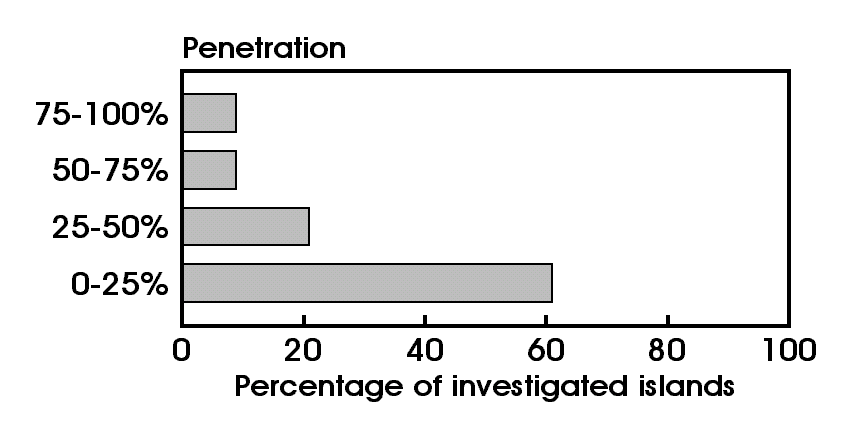
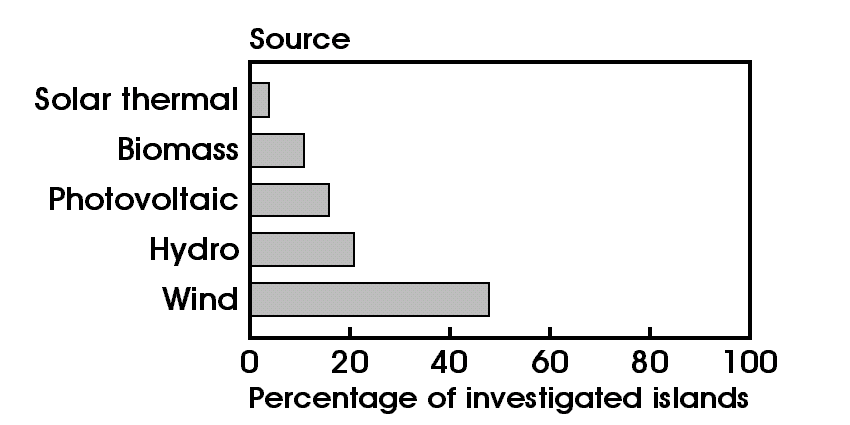
Renewable energy penetration in the power sector is a good indicator of how much renewable energy contributes to the energy supply on the investigated islands. The average figure for renewable energy penetration is about 25 per cent (Figure 1). Approximately 20 percent have more than half of their electricity generated from renewable energy sources. This figure is extremely high, not only compared with the island average, but also when compared with the world average. The kind of renewable energy source utilized varies between the investigated islands (Figure 2). But by far the most utilized renewable energy source is the wind — nearly 50 per cent of the islands have utilized wind-power. Twenty per cent of the islands have experience with utilizing hydropower. The percentage is almost similar with regard to the utilization of photovoltaics.
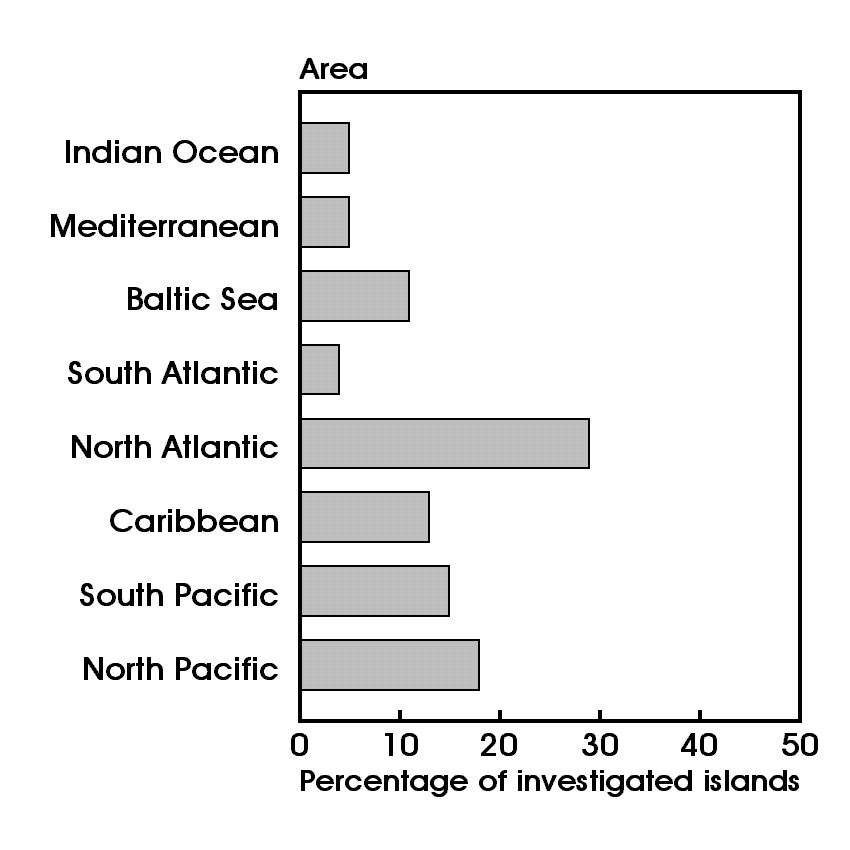
The islands investigated are scattered all over the world (Figure 3), but almost one-third are located in the North Atlantic. The sovereignty status of the islands is clear — 82 per cent of the islands are non-sovereign.
Are islands interesting when it comes to questions of the development of renewable energy on a local and global scale? The answer is yes for two primary reasons. The first reason is the competitive situation for renewable energy technologies and the excellent renewable energy sources. These two major barriers for the dissemination of renewable energy sources do not exist on most islands. There are, of course, other barriers such as the technical, institutional, and the political. The most significant barrier is the financial aspect — the high initial capital costs associated with the purchase of renewable energy technologies. This is clearly illustrated in the review. Approximately 80 per cent of the islands with renewable energy experiences are non-sovereign. They are formally connected to a mainland entity and, therefore, have substantial economic support in all sectors, such as infrastructure among others. The island states do not have this financial base of support so most of them are dependent on bilateral, regional and multilateral aid agencies. Is it possible, through a concentrated effort by donors, to substantially increase the utilization of renewable energy sources on many small island states? To do so would contribute to the social and economical development of the island state and thereby improve the local and global environment. The second reason islands are interesting with regard to the development of renewable energy is that experience gathered there can serve as demonstration projects for mainland local communities, not only in developed countries, but also in developing countries. There are about 2.5 billion people living outside a national grid in developing countries. These people need electricity services and so lessons learned from renewable energy islands are highly relevant within this context. Furthermore, islands can serve not only as demonstration projects for local communities in the developed and developing world, but through concentrated efforts some small island states can serve as demonstration nations. Despite their size small island states could set a positive example to the rest of the world’s nations. Further informationThe report Renewable Energy on Small Islands is available from: Thomas Lynge Jensen, Forum for Energy and Development, Landgreven 7, 1301 Copenhagen K, Denmark. Fax: 45-33-121308. Email: tlj@inforse.org. Web: www.inforse.dk/fed/index.htm. The report is also available in Adobe PDF format (674kb) at the Council for Sustainable Energy’s web site: www.energimiljoeraadet.dk/publikationer/pdf/veoe.pdf. An update will be also available on this site. Conference announcementOn the 15th and 16th September 1999, the Conference on Renewable Energy Islands will take place on the Danish island of Ærø. Located on Ærø is a windmill park and the world’s biggest (8,000 m2) solar district heating plant. It is anticipated that over 150 participants will attend from national and local governments, utilities, research institutions, and regional and global organizations. The main objectives of the conference are to exchange experience, increase awareness and establish a platform for future cooperation and networking. Primary themes for discussion are the local and global agenda for energy, environment and development, organization, financing, awareness and available and needed resources. The conference is organized by the Forum for Energy and Development, which also hosts the International Secretariat of the International Network for Sustainable Energy (INFORSE). For further information on the conference contact Thomas Lynge Jensen at the above address. 
|