Forget Computers. Here Comes the SunApril 14, 2006 John Markoff, nytimes.com
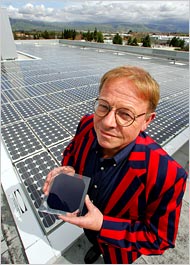
SAN JOSE, Calif. T. J. Rodgers is surrounded by a sea of silicon wafers on the roof of his company's headquarters in a Silicon Valley industrial park. No, not the ones that Mr. Rodgers, who founded Cypress Semiconductor in 1982, used to make high-speed computer memories or the newer specialized chips that go into iPods and high-end Mercedes-Benzes. These wafers are soaking up the sun's rays and turning them into electricity. On the roof, he fusses over the occasional weed that has grown up in the cracks between the panels and speculates about using robots to keep the glass surfaces of the panels clean. But it is nothing like the problems of manufacturing computer chips in superclean rooms. "You don't have to do too much of anything," he said. "You just wash them down. All you want to do is get the stuff off."
Mr. Rodgers has plenty of motivation to keep an eye on his roof. The growth of his company may soon depend on SunPower, a small subsidiary that employs the six-inch-square silicon wafers to make a more efficient solar cell. The contrast between the two uses of silicon could not be more pronounced. As it turns out, the fledgling solar-cell industry uses just about as many silicon wafers as the chip industry does, but the resemblance ends there. Today, solar cells are a tiny niche in the energy business — rapidly expanding to be sure, but without the potential for exponential gains in performance and falling costs that are hallmarks of the computer world. Indeed, the solar-cell industry is reliant upon government subsidies, to the consternation of Mr. Rodgers, an outspoken libertarian. "The culture that got built is what I call a grant culture," he said. "They're all pitching to the U.S. government, looking for funding." Such criticism aside, the subsidies are in place, both in the United States and Europe, and Mr. Rodgers is ideally positioned to capitalize on the government support he has long railed against. "I can make a good profit for my shareholders," he said, "and provide a lot of good eco-stuff to the world as well." The paradox is that Mr. Rodgers, 58, who has long been a free-market iconoclast, even by the tough-guy standards of the valley's chip industry, may end up striking pay dirt by moving from the cutthroat world of computer processing power to the more sensitive realm of solar power. At the same time, by marrying the silicon-based technology of computer chip making with the ability to produce photoelectric cells more effectively from the same raw material, he is infusing the solar industry with fresh energy. "I think T. J. has found a lot of good things in SunPower," said Alan F. Shugart, a Silicon Valley disk-drive industry pioneer and a Cypress board member. "The tail could easily end up wagging the dog." In Wall Street's eyes, the tail is already in motion. Cypress owns 85 percent of SunPower, which went public in November. Cypress is valued near $2.5 billion, with its stock trading at $17.24. SunPower's capitalization is about $2.38 billion; since its offering, its stock has risen from $24.42 to a closing high of $44.07 on March 1. This suggests that much of the value of Cypress these days comes from SunPower. "It appears that Cypress has been able to leverage its manufacturing process expertise," said Louis Gerhardy, a semiconductor analyst at Morgan Stanley. "T. J. found an industry that had been around for 30 years but now is showing new opportunities." If he succeeds it will be because six years ago, Mr. Rodgers, who has the build of a former athlete to go with his straight blond hair and owlish glasses, decided to play a hunch when he ran into an old Stanford University graduate school mate at a coffee shop. "How are you doing?" Mr. Rodgers recalled asking. "Well, I'm about to go out of business," replied Richard Swanson, an electrical engineer who had founded SunPower to make a highly efficient solar-power cell. The company had some success in specialized applications, but with energy prices relatively low in the early 2000's, the consumer market had not developed as he had hoped. "We've been on the edge, and I can't cut it anymore," Mr. Rodgers recalled Mr. Swanson telling him. He was about to lay off half his work force of 40 people. "Why don't you have me over and I'll take a look," Mr. Rodgers responded. At the time, his own chip business was not exactly shining. In the previous three years, he had pushed Cypress into niche markets for the communications industry. While those markets were still growing, the dot-com collapse in 2000 had undermined any hope that Cypress would become a major power in the data communications world.

|
||||