
Sharp develops solar cell with world’s highest
conversion efficiency of 36.9%
Nov. 7, 2011 - Nilima Choudhury - pv-tech.org
 After
eleven years of research and development, Sharp Corporation
has achieved the world’s highest solar cell
conversion efficiency of 36.9% using a triple-junction
compound solar cell in which the solar cell has a
stacked three-layer structure. Measurement of this
value, which sets a new record for the world’s
highest non-concentrating conversion efficiency,
was confirmed at the National
Institute of Advanced Industrial Science and Technology (AIST). After
eleven years of research and development, Sharp Corporation
has achieved the world’s highest solar cell
conversion efficiency of 36.9% using a triple-junction
compound solar cell in which the solar cell has a
stacked three-layer structure. Measurement of this
value, which sets a new record for the world’s
highest non-concentrating conversion efficiency,
was confirmed at the National
Institute of Advanced Industrial Science and Technology (AIST).
Compound solar cells utilize photo-absorption layers
made from compounds consisting of two or more elements,
such as indium and gallium. Due to the high conversion
efficiency, compound solar cells have been used primarily
on space satellites.
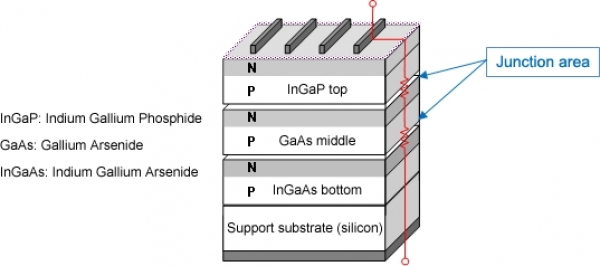
In 2009, Sharp succeeded in improving cell conversion
efficiency to 35.8% based on proprietary technology
that enabled efficient fabrication of a stacked triple-layer
structure with InGaAs (indium gallium arsenide) as
the bottom layer. This latest increase in conversion
efficiency was achieved by improving the maximum
power output of the solar cell by reducing the resistance
of the junction areas necessary to connect the solar
cell layers in series.
Japan’s New
Energy and Industrial Technology Development Organisation (NEDO), which promotes research
and development as well as disseminating industrial
energy and environmental technologies, aided this
breakthrough.
In the future, processes for transferring ultra-thin
PV layers onto film substrates will make lightweight,
flexible solar cells possible.

|