
Avenal in ascendance: Taking a closer look at the
world’s largest silicon thin-film PV power
plant
Aug. 18, 2011 - Tom Cheyney - pv-tech.org
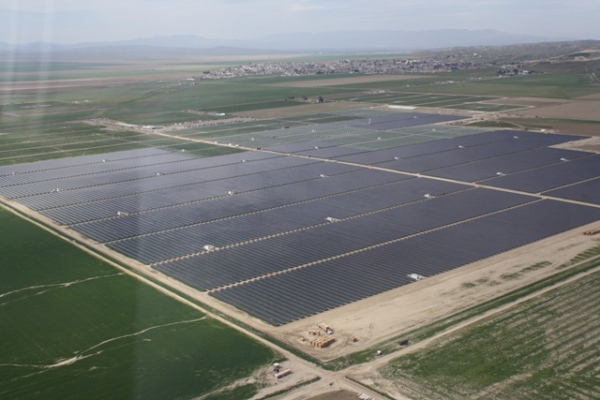 One
of the largest photovoltaic power plants in the world
started officially sending electricity to the grid
earlier this month—and hardly anyone seemed
to notice. The commissioning of the 45MW (AC) Avenal
Solar Generating Facility in rural Kings County,
CA, was drowned out among the buzz of First Solar’s
gigawatt-scale PR burst around the Agua Caliente,
Topaz, Desert Sunlight, and Copper Mountain Solar
II installations and SunPower’s imminent kickoff
of construction on the California Valley Solar Ranch
site. After all, what’s a mere 45MW compared
to the nearly 1.8GW represented by those megaprojects? One
of the largest photovoltaic power plants in the world
started officially sending electricity to the grid
earlier this month—and hardly anyone seemed
to notice. The commissioning of the 45MW (AC) Avenal
Solar Generating Facility in rural Kings County,
CA, was drowned out among the buzz of First Solar’s
gigawatt-scale PR burst around the Agua Caliente,
Topaz, Desert Sunlight, and Copper Mountain Solar
II installations and SunPower’s imminent kickoff
of construction on the California Valley Solar Ranch
site. After all, what’s a mere 45MW compared
to the nearly 1.8GW represented by those megaprojects?
In Avenal’s case, not only has it joined the
cast of the current top 10 largest operational PV
plants, the site stands as what may be the biggest
silicon thin-film-based solar generating station
on the planet. A closer look at Avenal also provides
an opportunity to examine two of the solar industry’s
trickier metrics: AC:DC conversion ratios and kilowatt-hour
output.
The co-owners of Avenal, Eurus
Energy America and
NRG Solar, didn’t offer a wealth of details
in their announcements, but a bit of Googling revealed
additional info both on their websites as well as
on the site of general contractor Quanta
Services.
Avenal is actually three projects in one, all located
west of the Kettleman Hills just off Highway 33 in
central California--Sun City (20MW), Sand Drag (19MW),
and Avenal Park (6MW)—each of which has signed
20-year power purchase agreements with Pacific Gas & Electric.
According to Quanta’s project portfolio, the
site features Japanese-made Sharp thin-film modules
(about 450,000 of the tandem-junction units) in fixed-tilt
arrays, Emerson inverters, a 34.5kV substation (designed
and built by Quanta subsidiary and project lead,
Ryan Co.), and a generating capacity ample to provide “enough
energy to power 36,000 homes.”
NRG’s project factsheet adds some other details,
such as the combined acreage of the sites (500),
while the Eurus site lists the overall project cost
as $220 million. A quick math turn shows that maps
out to about 11.1 acres and $4.9 million per megawatt
AC installed (total balance of systems, etc.).
One other info-bit on the Quanta site triggered
my geekish curiosity: The converted DC equivalent
of the plant’s AC nameplate rating is listed
as 57.7MW. A back-of-the-envelope (BOTE) calculation
reveals the DC:AC ratio for Avenal to be about 1.28:1.0,
a much higher number than I had seen previously.
My own standard BOTE DC:AC ratio is 1.2:1.0 (or
flipped over, 0.8:1.0, AC:DC), a number used publicly
by the likes of First Solar, PG&E, and others.
Other ratios in use are even tighter.
SolarPlaza’s Tom van der Linden told me that
the group uses a 0.87 AC to 1.0 DC metric in its
just-published top 10 solar PV power plants report.
Southern California Edison calculates the ratio
at roughly 0.9MW AC of power produced for every 1.0MW
DC installed on its owned and operated systems when
they’re operating at peak generating capacity,
according to utility spokesman Gil Alexander.
Since the Avenal plant came online Aug. 5, it’s
not surprising it didn’t make the deadline
cutoff to be included in SolarPlaza’s brand-new
top 10. If it had been listed, the 45MW (AC) site
would crack the chart in 6th place, if the 57.7MW
(DC) equivalent were used, or it would land in the
10th spot at about 51.5MW (DC), if the Dutch publisher/consultancy’s
metric were used. In either case, it means that of
the current 10 largest PV generating systems, four
employ thin-film technology.
But the top 10 ranking would also be shaken up if
First Solar’s 1.2:1.0 ratio were used. The
undisputed number one--the 80MW (AC) Sarnia project
in southern Ontario, Canada—receives a 92MW
(DC) nameplate rating by SolarPlaza, but would jump
to 96MW if First’s own ratio were applied.
The current holder of the sixth slot—Copper
Mountain Solar I (Boulder City)—has its 48MW
(AC) converted to 55MW (DC), but would jump to 57.6MW
if the CdTe leader’s metric were the norm.
The horse race between Avenal and Copper Mountain
gets more complicated when comparing the DC equivalents
offered by the project owners/EPC firms. Although
the Nevada site is obviously 3MW larger than the
California farm in terms of their respective AC ratings,
the ratio conversion apparently used by Quanta pushes
Avenal past Copper Mountain on the DC side.
I reached out to someone with intimate knowledge
of utility-scale PV projects and EPC, who shared
some insights with me on the condition that he remain
anonymous. Noting that the issue of DC:AC ratios
is “a very good (and rarely asked) question,” he
explained that “a novice will design so that
the DC ratio peaks at the point of maximum sunlight
(roughly noon time). Depending primarily on the modules,
this will yield a ratio around 1.2.”
“However, if the goal is to maximize energy
production (and there is sufficient land), you can
design with a higher ratio, thus generating more
energy on the shoulders of the parabola but clipping
at the peak of production,” he said. “For
modules that perform well at lower light conditions
(e.g., CdTe thin-film modules), this can be a big
and very important difference. Add in the complexities
of trackers and other details, and there is further
optimization to be had. Again, the details are highly
proprietary and few have optimized this.”
As a result of the range of optimization options,
in some cases, he told me, the DC:AC ratio can even
be quite a bit higher than Avenal’s 1.28:1.0.
But the conversion ratio of the installed modules
is just the tip of the iceberg when it comes to how
a utility-scale solar power plant is designed and
how much power it actually is capable of generating.
Is the owner’s goal to “maximize energy,
maximize revenue, or maximize power and therefore
peak production?” the source asked. Is the
project size under any kind of space or land constraint?
In the case of the megafarms starting to sprout up
in the southwest US and other regions, it rarely
is.
This is “very complicated” business,
he stressed. “There are many factors that,
in the end, must be run through the model. Consider:
geographic location, all angles of the modules, module
type, ambient temperature, weather patterns, system
design parameters, parasitic loads, module type,
inverter, etc.”
Which brings us back to a key piece of information
for any solar power plant, especially larger ones:
the annual kilowatt/megawatt/gigawatt-hour output
or energy yield. Missing from any of the respective
companies’ documents or websites is the project’s
expected MWhr/GWhr metric. Both Eurus’s Mark
Anderson and NRG’s Lori Neuman told me that
it’s their company’s policy not to release
that information.
As it turns out, this information is a matter of
public record and exists both in the California
Public Utilities Commission’s final advice letter for the project and in the California
Energy Commission’s
investor-owned utilities contract database.
Both documents show Avenal with a rated capacity
of 48MW, or 3MW more than what was actually built.
I’ve been unable to find out what happened
to those other megawatts, but the companies involved
have consistently been reporting the size as 45MW
since the project was first announced and began construction
last year.
The data I sought, listed under the categories of “minimum
expected deliveries (GWh/yr)” and “maximum
expected deliveries (GWh/yr)”on the CEC spreadsheet—there
seems to be no difference between those two, btw—show
the silicon thin-film-powered system anticipated
to provide 77GWhr/yr. After recalculating that number
based on the actual 45MW size of the plant, the figure
shrinks to about 72.2GWhr/yr.
A BOTE formula for estimating kilowatt-hours per
year goes as follows: take the installed capacity
of the system, say 10MW, and multiply that by the
average number of sunny hours per day, say 6. Then
take that product and multiply it by the estimated
number of sunny days per year, say 300 for well-irradiated
parts of California, and you come up with a very
rough approximation of the total annual megawatt-hour
output of that system; in this case, about 18GWhr/yr.
If we apply that same formula to Avenal, we would
overshoot the stated gigawatt-hour total, hitting
81GW. But if you ratchet back the numbers, reducing
the sunny days per year to about 267, the new total
is right around 72GWhr/yr.
Of course, this BOTE calculation flattens out all
the optimizable variables cited by the expert source
earlier and doesn’t address the whole AC:DC
controversy again. (But then again, I’m an
AC kinda guy.)
Earlier I mentioned that the Avenal project principals
have claimed the power plant would provide sufficient
energy yield to power 36,000 homes. Anyone who’s
perused reports about utility-scale solar is familiar
with this statistic, but not everyone may realize
that the “house count” is nonstandardized
and can vary widely, depending on several factors
such as load factor, consumer’s consumption
pattern, energy efficiency, location and climate,
level of insolation, type of PV system, etc.
But one key metric, one that is often misstated
or at least left out by project developers/owners,
is whether the number of households cited is the
total that will be served by a system during peak-demand
generating hours or the customers who will have their
electricity needs met on an average annualized basis.
SCE’s Gil Alexander helped put this into perspective.
He explained that the average Edison residential
customer in the company’s 15 Central and Southern
California county service area uses about 600KWhr
of electricity per month, or 7.2MWh/yr. (PG&E’s
average customer uses 6.6MWh/yr, sources say.)
The utility consistently—and conservatively—states
that for every megawatt of solar installed (and again,
this is for plants owned and operated by Edison),
an average of 650 residential customers are served
when the system is generating at peak capacity. That
same 1MW facility produces close to 1500MWhr/yr,
or enough to serve 207 average residential customers,
according to the spokesman.
“It’s the old ‘capacity factor’ issue,” he
noted. “Maximum generating capacity under perfect
conditions versus energy produced over time.” SCE
uses a capacity factor of 16-20% in its own model,
he added.
Alexander then shared an related anecdote. “A
couple of weeks ago I hosted a journalist at our
[5MW AC] Porterville solar station. As it happened,
we arrived at the site at a point when the inverters
said we were producing 98% of the nameplate capacity.
This was because the sun was at its peak overhead
and there was a slight cloud cover meaning there
was a ton of sunlight but the panels weren't as hot
as they can get in clear sunlight, [since] very hot
panels don't produce power as efficiently.
“So, at that moment, we were producing enough
power to meet all the needs of 3,250 average Edison
residential customers. However, to state the obvious,
that does not mean the site can meet all the needs
of 3,250 customers when conditions are not peak.”
Unfortunately, not all project announcements include
verbiage that clarifies whether the “number
of households served” figure is based on peak-time
system performance or annualized energy production.
First Solar, for example, has used phrases like “at
full capacity” and “during peak demand
hours of the day.”
In the case of Avenal, this was unstated though
it’s pretty clear from some quick calculations
that the “36,000 homes” stat—about
800 customers per megawatt—represents the system’s
peak-demand output capability. Given PG&E’s
residential kilowatt-hour average, the annualized
number of households comes in at 10,930 residences
(243 per megawatt); like the similar SCE figures,
the yearly amount rounds out to less than a third
of the peak number.
Despite the slightly loose use of terminology and
numbers-gamesmanship by Team Avenal, they still have
bragging rights for awhile, given their overlooked
status as the biggest tandem-junction (or any other
kind of amorphous silicon) thin-film PV power plant
in the world.
But their roost-ruling days may be numbered. Construction
on a 73MW project, also using Sharp TFPV panels,
is reportedly under way in the Lop Buri province
of Thailand, north of Bangkok. Although there have
been no recent announcements by NED, Mitsubishi,
Sharp, or the other parties involved, the original
timeline called for the power plant to be operational
by the end of 2011.
If true, the Thai installation would overwhelm Avenal
in the installed capacity category and vault into
the top tier worldwide, regardless of whether that
73MW is—and I can’t confirm it either
way though I suspect it's direct current—an
AC or DC nameplate rating.

|