 Rooftop solar panels overloading electricity gridOct. 13, 2011 - Annabell Hepworth - theaustralian.com.au
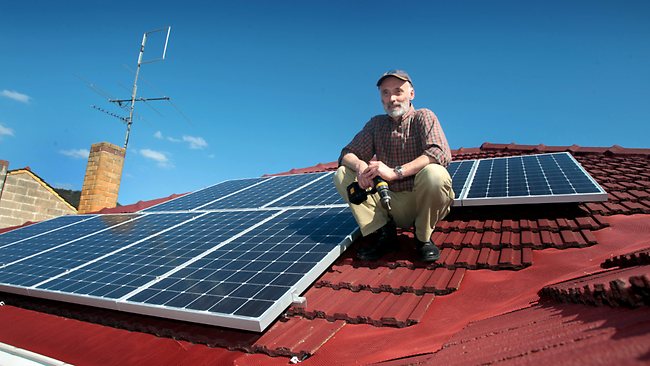
THE runaway take-up of rooftop solar panels is undermining the quality of electricity supplies, feeding so much power back into the network that it is stressing the system and causing voltage rises that could damage household devices such as computers and televisions. Power distribution lines and home wiring were designed for electricity to flow from power stations to appliances, but households with solar panels do the reverse of this. One of Australia's biggest electricity network providers, Ausgrid, yesterday warned that there was a "significant likelihood" that costs would have to rise because of the impact of the solar photovoltaic cells. In a letter to the NSW pricing regulator, obtained by The Australian, Ausgrid warns that in areas with a high concentration of solar cells, voltage levels can rise and this can have "consequences for appliances and equipment in customers' homes". It can also cause solar systems to switch off. In Queensland, some new applications for rooftop solar systems have been rejected and Energex now urges customers to check that a solar PV system can be installed without threatening the operation of the network. In Western Australia, Horizon Power has set limits on how much renewable energy can be installed in a system without affecting the power supply. Horizon is rejecting applications for new renewables installations in Exmouth and Carnarvon, and accepting them only from households, schools and not-for-profit organisations in Broome and Leonora. Energex spokesman Mike Swanston said it was becoming difficult for electricity distribution authorities to set up the power system to ensure correct voltages when some houses in a street had solar and others did not. "It is similar to the water network - the pipes get smaller and the pressure is designed to be lower as you get closer to the house," Mr Swanston said. "Start pumping water backwards into the smaller household pipes, and all sorts of strange things happen." Energy Networks Association acting chief executive John Deveraux said the problem would only get worse as more rooftop solar panels were installed and the systems got bigger. In southeast Queensland alone, more than 22,300 rooftop solar systems were installed in the first three months of this financial year - more than the 19,000 installed in the 2009-10 financial year, according to Energex. Federal Labor's target of producing 20 per cent of electricity from renewable sources such as solar power by 2020 has pushed up demand for the rooftop PV systems. So, too, have state-based schemes that pay generous feed-in tariffs to households for injecting power back into the grid. Meanwhile, a flood of cheap solar panels being made in Asia and imported into Australia has offset moves by the government and some states to wind back their subsidies. Power quality problems are worse in rural areas as the network is sometimes weaker and there is generally more space, meaning that bigger solar PV systems with capacities of 5 kilowatts or more are being installed, compared with the 1kW-3kW systems more common in urban areas. Essential Energy, which operates powerlines in country NSW and parts of southern Queensland, wants NSW to follow Queensland's lead on introducing a cap on solar PV systems of 5kW to avoid power quality problems. Endeavour Energy, which runs the network in Sydney's greater west, warns that some solar panel installers have not done voltage checks and other measurements to ensure the solar PV system operates adequately. "The biggest problem we've got with the accelerated rollout is making sure every installation is fully compliant," Endeavour's general manager of network development, Ty Christopher, said. Adelaide solar panel installer Chris Hart said the problems were worse in the summer months, when airconditioner use added to the stress on the system. Mr Hart, who owns EcoSouth Solar Electricity, said areas with a lot of solar panels pushed the voltage up to the maximum allowable level, triggering shutdowns in the individual systems and taking the load off the grid. He said solar systems "drop out for a few minutes" when voltages get too high, a phenomenon known as "tripping out". "Then they try to come online again and it pushes the voltage up again and it's very wearing," he said. "That's the problem with having too much solar in an area where the local authority hasn't got enough wires or copper in the street to hold the voltage down." Mr Hart said the size of conductors and cables in the streets would have to be upgraded "so it can handle lots of solar, versus times when there's lots of load and no solar". "If you get a very, very hot night and there's obviously no solar, the mains voltage is going to drop a lot," he said. "If your wires aren't up to it, you've got a problem." The network companies say measures such as retrofits and battery storage can stop the "tripping" but can be costly. In Western Australia, Horizon Power has set "hosting capacity limits" for renewable energy installations. 
|
Updated: 2003/07/28