 The U.S. Could Get 20% of Power From Solar Sited Beneath Transmission LinesOct. 18, 2011 - John Farrell - thinkprogress.org It could. Transmission right-of-way corridors, vast swaths of vegetation-free landscape to protect high-voltage power lines, could provide enough space for over 600,000 megawatts of solar PV. These arrays could provide enough electricity to meet 20 percent of the country’s electric needs. (Note: There may not be good interconnection opportunities for solar under these huge towers, so this should be read as a land use discussion rather than technical analysis of interconnection to the grid.) It starts with the federal Government Accountability Office, which estimates there are 155,000 miles of high-voltage transmission lines in the United States (defined as lines 230 kilovolts and higher). According to at least two major utilities (Duke Energy and the Tennessee Valley Authority), such power lines require a minimum of 150 feet of right-of-way — land generally cleared of all significant vegetation that might come in contact with the power lines. That’s 4,400 square miles of already developed (or denuded) land for solar power, right under existing grid infrastructure. Of course, the power lines themselves cause some shading, as may nearby trees (although the New York Public Service Commission, and likely other PSCs, has height limits on nearby trees that would minimize shading on the actual right-of-way). To be conservative, we’ll assume that half of transmission line right-of-way is unsuitable for solar. That leaves 2,200 square miles of available land for solar. With approximately 275 megawatts (MW) able to be installed per square mile, over 600,000 MW of solar could occupy the available right-of-way, providing enough electricity (over 720 billion kilowatt-hours) to supply 20 percent of U.S. power demands (note: we used the average annual solar insolation in Cincinnati as a proxy for the U.S. as a whole). Making big strides toward a renewable energy future doesn’t require massive, remote solar projects. We can use existing infrastructure or land to generate significant portions of our electricity demand. Transmission right-of-way, providing 20 percent of U.S. electricity from solar, is just one piece of the puzzle, with another 20 percent possible from using existing rooftops, and a solar potential of nearly 100 percent from solar installed on highway right-of-way. Solar can help achieve a 100 percent clean — and local — energy future. 
|
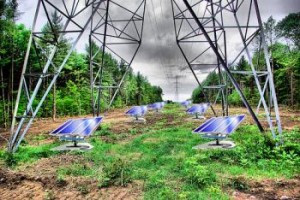 What if the U.S. could get 20 percent of its power
from solar near transmission lines without covering
virgin desert?
What if the U.S. could get 20 percent of its power
from solar near transmission lines without covering
virgin desert?Updated: 2003/07/28