
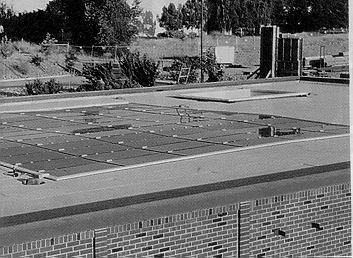
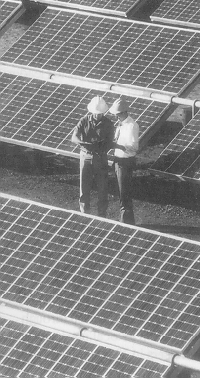
2.2 Residential PV Pioneer Project The 1993 SMUD PV Pioneer Project established
a partnership with customers willing to assist
in the early adoption of photovoltaic (PV) technology.
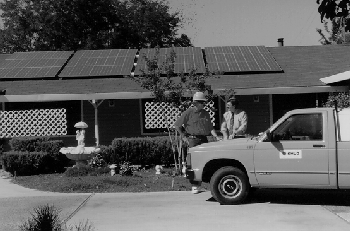
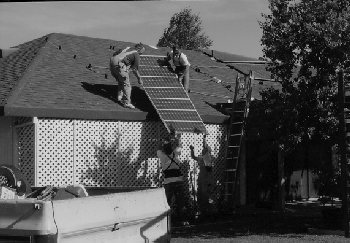
Under the PV Pioneer Program, SMUD purchases,
installs, owns, and operates 100+ residential
rooftop PV systems, each about 4 kW, each year
(Figure 2 and 3). SMUD plans to continue adding
at least 100 PV Pioneer systems each year for
5 years.
|
|||||||||||||||||||||||||||||||||||||||||||||||||||||||||||||||||||||||||||||


| PROJECT-YR | COST1 | ADD COST | COST | /kWh5,6 |
| SUB - 19932 | $6.26/W | $3.89/W | $10.15/W | 32 |
| SUB - 19943 | $6.68/W | $1.07/W | $ 7.75/W | 21 |
| SUB - 19942 | $6.10/W | $0.87/W | $ 6.97/W | 19 |
| SUB - 19952 | $5.71/W | $0.91/W | $ 6.62/W | 18 |
| RES - 19933 | $7.70/W | $1.08/W | $ 8.78/W | 23 |
| RES - 19943 | $6.23/W | $0.90/W | $ 7.13/W | 20 |
| RES - 19953 | $5.98/W | $0.89/W | $ 6.87/W | 18 |
- Turn-key contract cost up to utility interconnection without tax, bonding or utility add-on costs.
- Single axis tracking system. Includes credit for Energy Production Factor (EPF) [for single-axis tracking, EPF = 1.23 compared to fixed tilt].
- Fixed, non-tracking system, EPF = 1.00
- Includes: interconnections, metering, site preparation, District labor, administration, overheads, tax, bonding, AFUDC, and other costs.
- Includes: O&M, does not include DOE cost-share.
- Preliminary estimate.
2.8 The Roof-top Resource
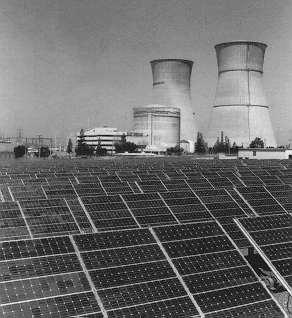
In metropolitan areas, hundreds of thousands
of square acres of residential and commercial
roof area, parking lots and transmission corridors
are setting unused in the sun. As Skip Fralick
of San Diego Gas & Electric Company pointed
out, "This rooftop area is the equivalent
of "free land" for photovoltaic generation:
it needs no development, environmental impact
statements, or extensions of transmission
lines." In Sacramento alone, these south to
west oriented roofs, parking lots and transmission
corridors represents the potential of hundreds
of megawatts of photovoltaic resource.
Power plant siting is normally a troublesome,
time consuming and expensive exercise, especially
in a suburban or urban area. However, over
the past three years, SMUD has sited about
340 PV power plants all across Sacramento
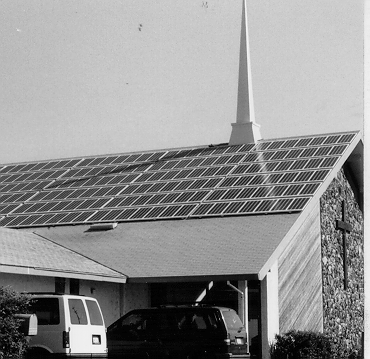
with little trouble or expense. Indeed, hundreds
of customers have paid extra on their utility
bill to host a SMUD PV power plant on their
roof. This ease of siting combined with the
environmental, modular and distributed benefits
of PV add substantially to the value PV brings
to the utility's energy mix.
3. A UTILITY PERSPECTIVE ON PV COMMERCIALIZATION
There is a critical need to accelerate and
complete commercialization of PVs to meet
our needs for grid-connected, utility applications
for year 2000 and beyond. Without a concerted
and collaborative effort we can not assume
that PVs will be ready to serve the utility
market when we will need it. Our actions today
are our investments for tomorrow.
The off-grid, "currently cost-effective" PV
applications are not sufficient to commercialize
and make cost-effective the grid-connected,
utility PV applications. We must continue
the process of the grid-connected market development
directly. These grid-connected applications
have value beyond energy and capacity and
include residential and commercial customer
sited PV for distributed generation and DSM
applications and substation/T&D sited
PV for grid-support value.
There are three central concepts necessary
to achieve the production levels and cost
reductions required for the accelerated commercialization
of photovoltaics for utility systems:
- Sustained Orderly Development (SOD)
- Commercialization path life-cycle costing
- Proactive leadership to stimulate early adoption
3.1 Sustained Orderly Development (SOD)
The solar industry needs a reliable and longterm market volume to develop and achieve longterm cost reductions required for full commercialization. Current "costeffective" utility markets have not provided sufficient market volume to accelerate commercialization. Demonstration and R&D projects alone do not accelerate the commercialization of new technologies. In fact, large, one-time purchases tend to dry up supply (and thereby increase price) without stimulating the increase in production capacity necessary for manufacturing cost reductions. Furthermore, manufacturers do not rely upon short term subsidies, mandated purchases, or set-asides in making investment decisions because these programs create "false markets." A combination of aggressive price reductions and commitments for substantial and sustained capacity acquisition is required for full commercialization of these technologies. Sustained orderly development and economies of volume for solar electric systems will result in the rapid development of a mature, costeffective solar industry.
3.2 Commercialization Path LifeCycle Costing
Technology development (or commercialization path) lifecycle costing, and not just "project" lifecycling costing, needs to be used. It is important to analyze total expenditures and total acquired capacity over the entire commercialization path. Higher costs for early applications can be a good investment if they contribute to accelerating the trend towards lower costs and higher performance. When solar investments are selected carefully and in collaboration with other stakeholders in renewable energy development, they can be among the wisest and, ultimately, the lowest risk investment that can be made, despite their higher initial capital costs.
3.3 Proactive Leadership to Stimulate Early Adoption
Sustained orderly development and accelerated
commercialization will not occur early relying
just on natural market forces. Accelerated commercialization
will not occur just by demonstration projects
and watching the cost curve. Utilities and other
potential bulk purchasers must commit to an
early and sustained series of substantial buys
to permit the industry to invest in expanded
production and automation. The "diffusion model"
of PV commercialization where high value applications
are identified and filled, then the next value
level developed is an important starting point.
It does not, however, result in a sufficient
aggregation of order commitments to allow the
needed expansion of production. The utility
grid-connected market needs to foster accelerated
commercialization with multiyear commitments
for substantial and continuing, multimegawatt
per year purchases.
While these early increments of PV may not be
cost effective on their own, they represent
a beginning of a cost effective process. Support
by the other stakeholders in the process, especially
by other utilities, the regulators and a reliable
DOE shared risk is required on a sustained,
multi-year basis to close the early cost-value
gap and make the process work. This support,
can not be on a year-to-year, stop and go basis.
It must be match the multi-year commitment that
the utility industry is making. The utility
community has taken the responsibility to get
this process underway now and to work with regulators,
customers and other stakeholders to make it
successful. The national Utility PV Group (UPVG,
now up to 90 utility members) has implemented
the first projects under TEAM-UP. Project TEAM-UP,
provides the initial part of a sustained, orderly
development process with a target of 50 MW of
utility PV purchases over a four year period.
Under this proposal the USDOE would provide
only about 30% of the estimated $513 million
program. As Andrew Vesey, Chairman of the UPVG
Board of Directors and Vice President of Niagara
Mohawk Power Corporation stated:
While TEAM-UP's partners may greatly help
to underwrite today's "cost gap", only the federal
government can close it. Critically, this federal
support must also be sustained. Funding
assurance is essential for gaining market and
supplier commitments, gearing up and implementing
the program, verifying the march down the cost
curve, and establishing the federal government
as a reliable partner throughout the entire
commercialization process.
The successful, accelerated commercialization
of utility PV applications will need to be a
collaborative effort of many participants. Utilities,
State and Federal agencies and other stakeholders
must join together. If manufacturers do not
continue to respond with aggressive forward
pricing, if utilities do not implement substantial,
sustained purchases, if DOE does not provide
a reliable and predictable multi-year costshare
absorbing a part of the early risk and if other
stakeholders do not proactively support the
commercialization process, this process won't
succeed.
4. PV COMMERCIALIZATION COST CURVE
Photovoltaics (PV) offer many advantages as
distributed generation systems, both as a supply
side option and as a demand-side management
(DSM) option. PV's are the most modular and
operationally simple of the clean, distributed
power technologies. From 1972 to early 1992,
PV module costs have been reduced 100-fold.
Already PV is a cost-effective resource for
a wide variety of remote and grid-independent
applications. The strategic, competitive advantages
of PVs will continue to increase as this cost
trend continues.
Despite tremendous price decreases, PV is still
too costly for most grid-connected applications.
In addition, cost-effective storage and the
related problem of intermittency of the solar
generated electricity continue to limit PV utility
applications.
Significant RD&D efforts are underway nationally
to develop more efficient batteries and other
electricity storage methods that will help to
resolve the storage and intermittency problems.
The problem of cost is being attacked on several
fronts. New PV materials and designs are being
developed to improve efficiency and reduce manufacturing
costs and niche markets are being developed
and exploited to continue the initial phases
of commercialization. Indeed, the current level
of production capability is all but sold out
for remote applications, consumer devices and
third world applications.
To achieve the next series of price reductions,
firm utility scale markets must be generated
and sustained to encourage the investments needed
in new technology and production. Utilities
can play a leading role in accelerating the
further commercialization of PVs through assisting
the development of utility PV markets. This
effort can reap benefits for our customers by
the resulting improvements in PV systems, distributed
generation support to our system and accelerated
reductions in PV costs.
Residential "rooftop" systems in the 2 to 4
kW range were costing about $15/W installed
in 1992. Substation applications were costing
about $10/W. The SMUD 1993 PV projects cost
about $7.70/W and for the 1994 PV projects averaged
about $6.44/W with a low of $6.10/W. The 1995
projects, despite constrained PV module supplies,
have continued tracking down the accelerated
commercialization cost curve with prices as
low as $5.71. With a sustained, widespread collaborative
effort, one could expect prices to drop below
$3/W by about the turn of the century. Figure
7 summarizes SMUD's analysis of the TEAM-UP
commercialization plan. It shows the expected
results of a sustained orderly development process
on the utility PV market based on a number of
market studies by the PV industry, analysis
by SMUD, UPVG and others and from sources from
DOE and the national labs.
In 1993 SMUD implemented its commitment to a
sustained orderly development effort starting
with the 640 kW of grid-connected utility PV
systems and a 5 year program of yearly PV Pioneer
and T&D buys. This 5 year program leads
to a 5 year period starting in 1998 where SMUD
will purchase about 10 MW per year of renewable
energy resources including PV. It is expected
that this multi-year effort would involve the
establishment of a new PV manufacturing facility
with part of it's production dedicated to the
multi-year, multi-megawatt utility commitment.
This is especially important since it is generally
agreed that "ramping up" to commercial scale
PV production for utility applications cannot
be at few kilowatts at a time, but rather in
annual sales in the multi-megawatt range. These
orders need to have continuity and be steadily
increasing. Early utility industry orders and
PV production increases need to be in the range
of 2-5 MW/year, and they must quickly (within
2-3 years) reach 10 MW/year and 50-100 MW/year
nationwide by the end of this decade. While
the efforts of a few utilities, such as SMUD,
can achieve some initial reductions of price,
the needed cost reductions for commercialization
will require a much broader effort. The level
of response to the 1995 TEAM-UP program is indicative
that this level of commercialization can be
maintained given only modest - but sustained
- DOE shared-risk. These efforts, supported
by all the stakeholders in the PV commercialization
process, will be necessary if PVs are to achieve
the cost reductions needed to meet our needs
in a reasonable time-frame.
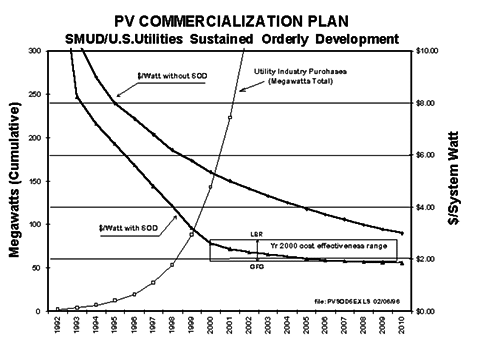
Figure 7. SMUD PV SOD Commercialization Cost-curve
Sustained Orderly Development (SOD) assumes
fully implemented, sustained TEAM-UP commercialization
effort.
Prices ($/W) are Turn-key system prices up
to meter, AC, PTC, 30 year life. Includes installation
and tax. Does not include Utility Add-on Costs.
Real 1994 $.
Year 2000 Cost-effectiveness range based
on: SMUD Gas Fired Generation (GFG) to Lower
Bound Renewables (LBR) Year 2000 costs. Fixed,
Rooftop PV systems. Tracking systems adjusted
by Energy Production Factor (EPF). Turn-key
system prices (total project cost less Utility
Add-on Costs). Does not include non-traditional
benefits such as Distributed Benefits.
5. SMUD'S CONTINUING SOD PV PROGRAM
During 1996, the District will continue its
efforts to accelerate the commercialization
of grid-connected PV applications and to define
and compare the relative costs and benefits
of the various models of utility PV applications
including the issues of systems ownership, shared
risk and benefits, levels of T&D benefits
and the general issue of the appropriate accounting
for all the value of distributed generation.
This information will be used to update the
analysis of PV benefit/cost as part of the integrated
planning process.
In Spring 1996, SMUD will release its multi-year
Request for Proposals for Renewables (RFP4R).
This RFP4R plans to obtain 50 MW of renewable
energy resource over a 5 year period, 1998 -2002.
As part of this solicitation, a 10 MW PV set-aside
has been included. Proposals are expected that
will provide for PV systems that will continue
the SMUD PV Program, meet or exceed the cost
goals indicated by the cost curve in figure
7 and result in significant PV and PV related
manufacturing and jobs in the Sacramento region.
Proposals are expected to be due to SMUD in
the summer of 1996 and SMUD expects to sign
contracts in early 1997.
6. COLLABORATIVE PV COMMERCIALIZATION
To succeed in accelerating the commercialization
of grid-connected utility PV applications, the
commercialization process must truly be a collaborative
effort. The PV industry needs to nurture the
grid-connected, utility market. They need to
aggressively forward price to foster this developing
market and to enable utilities to field systems.
They need to look at investing in this market
development now to create a profitable market
for the future. Utilities need to proactively
assist in developing a substantial, growing
and sustainable grid-connected utility PV market.
They need to aggressively account for the non-traditional
benefits of distributed PV generation and maximize
what they can afford to invest in early systems
to accelerate the cost reduction and commercialization
of grid-connected PV. Regulators need to recognize
that the long term best interests of the ratepayer
will be served by permitting and encouraging
modest early investments in higher cost PV today
when these investments will lead to earlier
and greater cost reductions of PV for the future.
They need to account for societal and economic
development benefits and the benefit of commercializing
a source of "green and inflation-proof" energy.
The Federal government needs to share the risk
by helping to fill the cost-value gap, a gap
declining as commercialization moves forward,
between how high utilities and regulators can
value PV benefits and how low the PV industry
can forward price grid-connected PV systems.
The Federal government must show that it can
be a reliable, sustained partner and not jerk
support up and down as the winds of the political
moment shift back and forth.
Each party needs to analyze their investment
for a "commercialization-path" life cycle cost
rather than a project-by-project basis. This
process must be developed as a sustainable,
orderly development of the market in a way that
the PV industry can invest with confidence in
new processes and manufacturing lines to lower
costs and that utilities and their regulators
can see accelerated and continuous progress
to cost-effectiveness.
Efforts such as the Utility PhotoVoltaic Group's
Project TEAM-UP with the USDOE and the PV4U
collaborative state working groups offer the
framework to make this collaborative commercialization
of the grid-connected, utility PV market succeed.
As was stated in Time Magazine of October 18,
1993:
Some of the biggest boosters of solar power
are bound to be utility companies, eager for
a clean source of electricity that will enable
them to produce more power without new billion-dollar
plants. Both as consumers of solar technology
and as the promoters of home solar panels, utilities
will drive much of the industry's growth into
the next century. "Utilities are beginning to
realize that they're going to have to get on
the solar bandwagon, says S. David Freeman,
(former) general manager of the Sacramento Municipal
Utility District (SMUD). "If they don't and
rates go up sharply, people are going to buy
their own solar panels and pull the plug on
the utilities." ... "Solar is competitive now
if you take the long view. And it's going to
be highly competitive by the end of the decade."
The use of solar energy has many benefits to
utilities, the our local communities and the
country in general. Solar technology reduces
the use of non-renewable resources. It is a
renewable and sustainable energy source and
helps improve air quality. PV power generation
systems are clean, quiet and environmentally
beneficial. They use no fuel and have no emissions.
Each MW of PV power generated by a plant with
a 25% capacity factor, will eliminate the production
of more than 20,000 tons of carbon dioxide and
more than 25 tons of NOx during its life as
compared to the cleanest fossil fuel plants
available for purchase today. Solar electric
systems stimulate economic development and employment
opportunities to a much greater extent than
conventional energy sources. They represent
a source of diversified, inflation-proof energy.
For all these reasons, PV represents an energy
supply that utility customers are demanding.
The question is, do we have the national will
to make a modest but sustained commitment to
the investment in our future that will make
this a cost-effective and substantial part of
our national energy mix in the timeframe that
we need.
National Solar Energy Conference, ASES Solar
96,
Asheville, NC, April 1996
This page Most Recently Updated August 9, 2000
DOE | EREN | NREL