 India’s Explosive Energy Growth :An Interview With P. Uma ShankarNov. 2, 2011 - Martin Rosenberg - energybiz.com
ENERGYBIZ What is the full scope of India's energy needs? SHANKAR If you look at the growth in energy demand, it is about 6 percent a year. We have a very large share of homes that are not connected to electricity. It was about 50 percent in 2005. It comes to about 70 million homes. We need to connect these homes to the grid to give them electricity. Part of that work has been done. One can look at about probably 40 million That have been provided access to the grid. We still have a long way to go. The per capital annual consumption in the country is quite low - about 700 kilowatt-hours. Our goal will be, first, to get all the people on the grid and then increase people's consumption to at least about 1,000 kilowatt-hours. ENERGYBIZ How long will it take get all Indians on the grid? SHANKAR It will take five years to get everybody connected. In about two to three years, the per capita consumption will cross 1,000 kilowatt-hours. It would require the electricity supply to grow about 8.7 percent a year. We have been growing by about 5.5 percent a year. By the end of this year, we will have about 200,000 megawatts of generation. This we will need to increase by about 15,000 to 20,000 megawatts per year for the next 10 years. ENERGYBIZ What share will come from nuclear power? SHANKAR The nuclear establishment is probably looking at 20,000 megawatts by 2020. ENERGYBIZ Are those projects under development already? SHANKAR Yes. They are already under construction. They all take quite some time. We currently have about 5,000 megawatts of nuclear generation. The mainstay of our generation is coal. ENERGYBIZ What about renewables? SHANKAR We got into a blending mechanism which blends the cost of conventional and solar power. We are looking at 1,000 megawatts of solar going into this mechanism. Once this gets off the ground, then the demand for solar panels will go up and the prices of panels will come down. Our goal for solar power is about 20,000 megawatts by 2020. ENERGYBIZ What role will smart grid play in India's development of its electricity infrastructure? SHANKAR The capacity to generate will increase. The grid will become bigger and bigger. It would be difficult to manually handle the grid. That is where you need automation and you need automatic controls to see that the grid is managed properly. You need to have the information that is almost instantaneous so that you have an idea as to the state of the grid. We would definitely have to smarten up the transmission system. ENERGYBIZ Where will you get the money to pay for this? Is the government subsidizing it? SHANKAR There is no need to subsidize this. The investment becomes part of the charge that is passed onto the consumer. ENERGYBIZ How is the transmission sector organized? SHANKAR The transmission business is almost entirely in the hands of government. India has 28 states that have their own transmission utilities that manage the transmission system within the state. ENERGYBIZ When it comes to electric infra- structure development, how does India compare with China? SHANKAR I think the yearly growth of Chinese generation capacity is far, far ahead. ENERGYBIZ Do you think there are things that you can learn from what China has been able to do? SHANKAR In terms of managing construction, yes. First, we were building 2,000 to 3,000 megawatts per year, and then we moved on to about 5,000 and now we are doing more than 10,000 megawatts. In the coming years, we will be able to do 15,000 to 20,000 a year. ENERGYBIZ When you talk about 50 percent of India not being connected to the grid and average per capita consumption is well below world levels, it sounds like this is a huge revolution in India. SHANKAR Right. Now more and more people are getting connected to the grid. As soon as we electrify a home, the first things that come in are a fan, lights and then television. It brings in a lot of other things such as safety. It extends working hours. It helps children to read. Television brings in a lot of information about the world and health. You also can have water systems in the village that provide drinking water for people. So it means some very big changes. How does it happen? From the substation, we extend the lines down to the village and then we provide connections to the households. ENERGYBIZ What will India look like in 15 years? SHANKAR Per capita electricity consumption will increase to 2,000 kilowatt-hours per person. ENERGYBIZ And will you become one of the leading economic powers anytime soon because of this? SHANKAR I think so. It will be a boost. In about 15 years we definitely will not have shortages. 
|
 INDIA
IS POISED for epic expansion of its electric
system as it races to power a fast-growing economy
and rising expectations of improved living conditions.
In the process, it has the benefit of being at the
forefront of deployment of just-developed technologies
that will give it one of the most advanced grids
in the world. To better understand the magnitude
of the challenge and its implications, EnergyBiz
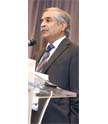
recently sat down with P. Uma Shankar, secretary
in India's Ministry of Power, at the GridWeek conference
in Washington. He is the third-highest official in
India's equivalent of the U.S. Department of Energy.
Our conversation, edited for style and length, follows.
INDIA
IS POISED for epic expansion of its electric
system as it races to power a fast-growing economy
and rising expectations of improved living conditions.
In the process, it has the benefit of being at the
forefront of deployment of just-developed technologies
that will give it one of the most advanced grids
in the world. To better understand the magnitude
of the challenge and its implications, EnergyBiz
recently sat down with P. Uma Shankar, secretary
in India's Ministry of Power, at the GridWeek conference
in Washington. He is the third-highest official in
India's equivalent of the U.S. Department of Energy.
Our conversation, edited for style and length, follows.