 Policy Options: Funding R&D
Graph
3. |
 |
There is concern that spending on energy innovation, from both private and public sources, may prove inadequate relative to the challenges confronting the world in the twenty-first century.United Nations Development Program |
Source:
Uranium Information Center
Research and development is the basis for technological
innovation, and is essential to commercialize renewable
resources. Current R&D financing in the private
sector is not sufficient for renewable technologies
to have technological advantage and to be cost competitive
with conventional energy resources. If our goal is
for a sustainable world, we must accelerate the rate
of R&D to mainstream clean energy technologies.
Technological advantage motivates investors to fund
R&D. An investment is sound when the technology
they invest in produces large returns. However, new
technologies that yield benefits for society do not
always provide monetary returns for the private sector.
Electricity from renewable resources, for example,
provides significant social benefits by mitigating
air pollution, and thereby allieviating the social
and environmental threats of disease and global climate
change. As discussed in the externality and subsidy
sections of this site, the market fails to include
such costs into the price of economic activities,
so we call this a market failure. Consequently, fossil
fuels appear cheaper in the marketplace because we
do not need to pay for their negative effects on society.
To make R&D for renewables attractive for private
investment, governments can implement policies to
internalize social and environmental costs into the
price for energy.
Another deterrent for private investment in R&D is the high initial cost of new technologies, particularly renewables. Once technologies are commercially available, their costs naturally decrease because of what we learn and experience from their application. Private firms understand this phenomenon, and often initially sell products for less than production costs because they know they will make profit after costs are driven down. However, it is difficult to recover costs for some technologies, including renewables. Nations that have overcome this dilemma have used public financial support to account for the initial costs. Denmark implemented policies such as subsidies and feed-in tariffs that account for their successful wind industry, now dominating 50% of the world market.
The UNDP outlines questions governments should consider
in their decisions to finance a field of energy research:
- Is it expected to contribute to achieving a transition to a sustainable energy future?
- Will it strengthen the competitiveness of (national) industries?
- Is the quality of the research infrastructure in the field of interest good enough?
- Limit the number of topics.
- Optimize the efficiency of public expenditures.
- Strengthen international cooperation.
- Enhance the application of knowledge.
Current R&D spending patterns
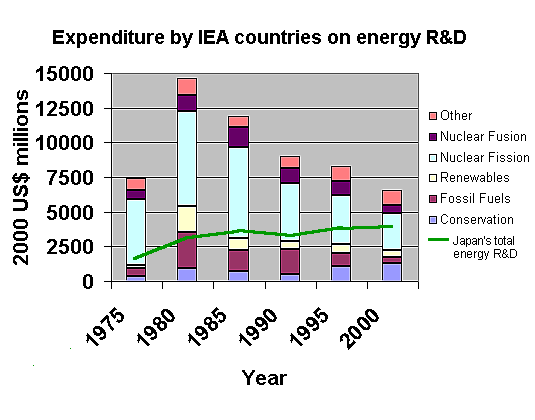
The IEA reports that overall energy R&D has declined in the past several decades. See Graph 3. In industrialized countries, reported public funding has fallen from $15 billion in 1908 to $7 billion in 2000. Eighty percent of expenditures in 2000 were by Japan and the US; 47% of this was for nuclear energy, 18% for energy efficiency, 8% for renewables and 6% for fossil fuels.
Although this information is disappointing, actual technological improvements for renewables has been tremendous in the same time frame. The IEA held a workshop on the needs for renewables and concluded that great strides in R&D have enhanced the industry recently. They determined the future to be bright for the industry. They also outlined what technological improvements are needed for each renewable resource. Click on the links below for more detailed information.
IEA's
main findings on recent technological breakthroughs
IEA's
R&D future priorities for each renewable resource
Developing nations must dedicate public funds to renewable R&D because technologies most adaptable to their communities (e.g., decentralized rural electrification) tend to be under-funded in industrialized nations. Many times developing nations also need a smaller production scale or have different operating environments that those in which the technologies were developed, in industrialized nations.
Another way to bring advanced technology to developing nations is through the "leapfrogging". Leapfrogging is the process of bringing modern, cleaner and more efficient technology to a place where they have dated or little energy infrastructure. This allows them to skip over the interim technologies that industrialized countries used. A common example is bringing cell phones to areas that do not have phones, rather than building the entire infrastructure for land lines and then later bringing in cellular service.
It is essential to fund capacity development to ensure the energy technology will be used effectively and maintained properly. Merely funding technological advancement or leapfrogging is not sufficient if the people can not use, repair and maintain the new equipment.
Cooperation between developing and industrialized nations is important for creating a sustainable energy system in the developing world. Some drivers to increase cooperation include joint ventures, licensing, or local subsidiaries, and others. South-South energy technology transfer is another great option for finding solutions to common challenges. Bilateral aid, multilateral programs and increased access to global capital markets enhance a developing country's ability to have joint energy R&D, to share information on clean energy policies and programs and to trade the technologies among one another.
|
International Energy Agency Additional R&D, along with determined policy support for market deployment, are viewed as the way to expedite the evolution of renewable energy to the point where it can double or triple its contribution to our energy needs. |
Policy Options
Nearly all policy tools described on GENI's policy driver pages can be used to stimulate R&D because the incentive for investment is determined by a competitive energy market, and nearly all policy options are geared toward this end. Targets, subsidies, taxes and feed-in tariffs all help equalize the costs of renewables to fossil fuels and increase market share, making the industry more competitive. However, to direct resources to R&D specifically, a nation can
- Formulate research priorities
- Direct public funding of specific R&D activities
- Implement technology forcing standards (i.e. vehicle emissions standards)
- Push corporate technology development agreements
- Initiate and stimulate networks of innovation
Resources:
Need for Renewables, International Energy AgencyEnergy for Sustainable Development, A Policy Agenda (pertinent information in Chapter 5), UNDP