 Policy Options: Targets & Timetables
Case studies:European Union's Indicative TargetsUS Renewable Portfolio Standards
Clearly, setting timetables for the generation of electricity from renewable energy sources is a powerful policy tool. It provides flexibility for industry to reach the target, while it encourages change. When a government establishes the target, this is an important political message that they value the commercialization of renewable energy technologies. Reaching the goal means that the market share of renewables increases. Naturally, costs will drop with increased production and a larger infrastructure base. Targets and timetables can be reached in different ways. In the US, there are Renewable Portfolio Standards that are complemented by a credit trading system. In the E.U., the White Papers that outline the indicative targets enumerate several state-funded programs to reach the target level. European Union's Indicative Targets: To derive 12% of total energy consumption and 22.1% of electricity consumption from renewable sources by 2010. To reach this goal, they will promote high-profile renewable energy projects, including 1,000,000 PV systems, 10,000MW large wind farms, 10,000 MWth biomass & integration of renewable energy in 100 small communities Graph 4 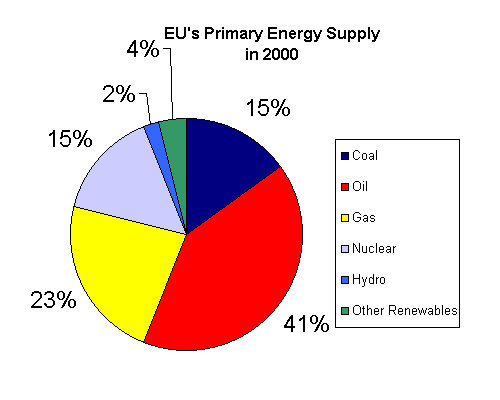
EU's implementation goals: to give fair market access without financial burdens by: 1. nondiscriminatory access to the electricity market fiscal and financial measures 2. new initiatives regarding bioenergy for transport, heat and electricity; increase market share of bio-fuels 3. promote use of renewables in the construction industry, both in retrofitting and for new buildings Benefits of the EU's targets: 1. the creation of 500 to 900 000 jobs 2. annual saving of fuel costs of ECU 3 billion from 2010 3. the reduction of fuel imports by 17.4% 4. cut of CO2 emissions by 402 mill. tons/year by 2010 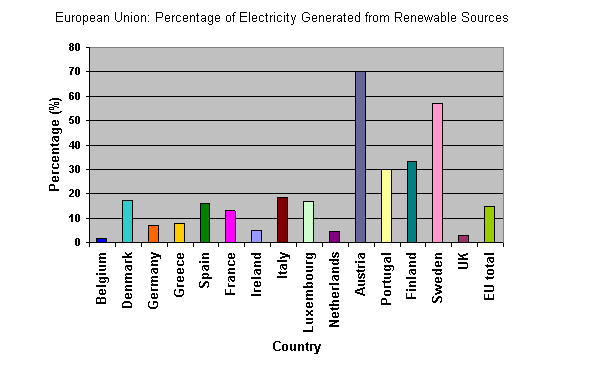 Source:EUROPA To see the programs of EU Member States from 1998-2000, go to the Commission of the European Communities' paper: Current Policies in Member States, see page 39 Resources:EUROPA: Renewable Energy White Paper
|
|