|
A Day in the Life of Terese
First, she wakes up around 7:30. Her duties begin right away, as she prepares a breakfast for herself, her husband, Bernard, and her two children. Breakfast is typically bread if she found time to walk to the closest boutique the day before, about a 45-min to an hour walk away. After eating breakfast, she makes two consecutive trips to Indare well, each time carrying about 30L of water. This takes about 2 hours, taking into account a necessary rest of around 15 minutes after each trip. A third morning trip is sometimes necessary if she plans on cooking food that requires more water in preparation, such as ngala, a traditional Senegalese dish of couscous, groundnuts, and sugar. Next in Térese's day, she must prepare the midday meal. Ethiouar, like other villages in the rural Senegal, relies almost solely on their own cultivation and animal raising for nourishment. A typical midday meal consists of a grain staple, such as rice or millet with a groundnut sauce and occasionally some type of meat. Prior to cooking millet, corn, or cowpeas, they must be pounded a pistol and mortar to a digestible consistency. Ethiouar actually has a grain-grinding machine, however it requires about 5L worth of gas to run, which costs around 2000CFA ($3). This is an expense that the village can't afford, meaning the job must be done manually by the women. This task is usually performed as a group effort, as it goes faster with more hands. After the pounding is done, Térese cooks the meal. Wood is the principal source of energy used for cooking, as it is free, charcoal being reserved for preparing tea. Cooking with wood is extremely less efficient than other modern energy sources, and although it is free, it takes about an hour to gather a bundle from the surrounding areas, which must be done three times a week. Cooking the midday meal with wood takes anywhere from an hour to two hours, depending on the meal.
In addition to these duties, she and the other women of Ethiouar spend time making bowls from casks and clay during the dry season when the cultivation work has yet to begin. They sell these in addition to woven bamboo placemats and container covers in Kédougou, the closest city, which is 18km away. Although this provides only a small amount of income, it is much needed. Since they have no method of motorized transport, they go to Kédougou whenever they can hitch a ride, or if necessary, they walk the 18km. Térese's productivity is clearly inhibited by a lack of modern energy use. She must spend a minimum of three hours each day collecting water, while some women recorded spending up to five hours during the days prior to a celebration or ceremony. If they had the energy source for a water pump, this would not be necessary. Also, she spends 40- 80 minutes each day pounding grain, even though a machine with gas can do this. Cooking with wood adds hours of additional labor to her day as well. No form of motorized transport means that she is reliant on others for all her traveling needs unless she walks or borrows a bike from someone in a neighboring village. This leaves little time for Térese or the other women of Ethiouar to pursue personal interests or new economic endeavors. The ConsequencesThis obstruction of productivity is especially visible in the realm of education. Térese is one of the only women in her village of her age that even went to school. She went to l'école primaire, the rough equivalent to our grade school, for three years, from the age of 7 to 10. Although she can't read or write, she is one of the few women her age in Ethiouar who can speak french. When asked why she didn't continue, she explained, matter of factly, that her help was needed in the village. The phenomenon of girls being taken out of school was confirmed by the men in the village as well, one saying, "S'il y a les problémes familial, les filles quittent l'école avant les garçons", when there are "family problems", girls are taken out of school before boys. Fortunately, this trend of girls being taken out of school is declining as education reform improves with each new generation as people begin to see education as a higher priority. Currently, all the girls in the village from the age 7- 16 are required to go to school, assuming normal circumstances (they aren't pregnant, ill, etc.) However, school still presents a challenge for girls who must share the burden of these duties as well as do schoolwork. Students descend the mountain in the early morning, walking the 2.5 km to l'école primaire while the older students go to school in Kédougou. When they return, they are expected to help with the daily chores that the gender roles demand, even if they are in school for the same amount of time as males and have equally as much homework. An extra handicap is that homework must be done before it becomes dark, as lack of electricity means households must rely on poor sources of light, mainly petrol lamps and candles. Homework such as writing or reading is difficult using only a petrol lamp or candle, and social activities usually take priority over a girl's homework for lamp use. The plight of Térese is one example of a day for a woman without access to electricity. There are 2 billion other people like her, constituting almost one third of the world's population. If you would like further information about Terese and her village please contact Kelly Hennigan at kelhennigan@hotmail.com <<back || index || next>> |
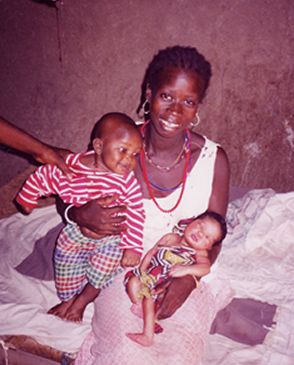 Térese
is a soft-spoken woman 20 years of age with two children
(as of spring 2003) from Ethiouar, a small village
in southeast Senegal. Terese's day is built around
chores that become obsolete with electricity.
Térese
is a soft-spoken woman 20 years of age with two children
(as of spring 2003) from Ethiouar, a small village
in southeast Senegal. Terese's day is built around
chores that become obsolete with electricity.
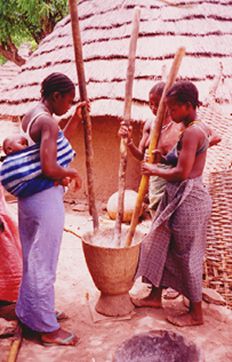 After
eating, Térese rests a little, having spent
the morning hours doing manual labor. She then repeats
this entire sequence of chores of getting water from
the well (usually only one time in the afternoon),
pounding the grain for the evening meal, cooking,
then eating. "Le jour c'est fatigant", her days are
tiring, she says, an understatement of her daily work.
After
eating, Térese rests a little, having spent
the morning hours doing manual labor. She then repeats
this entire sequence of chores of getting water from
the well (usually only one time in the afternoon),
pounding the grain for the evening meal, cooking,
then eating. "Le jour c'est fatigant", her days are
tiring, she says, an understatement of her daily work.