 Solving Wind Power's Variability with More Wind PowerAug. 11, 2011 - John Farrell - renewableenergyworld.com One solution to the variability of wind power is more wind.
But the same report also illustrated the smoothing effect when the output from these five wind sites was averaged. The following chart shows (in dark orange), the smoothing effect of output when the wind output was averaged over five sites.
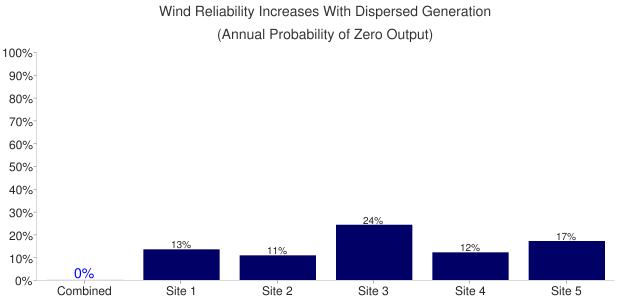
The impact is significant, and the optimized system varies from 15 to 50 percent of capacity, compared to individual turbine variability that's twice as large. Over a longer period (a year), the optimized (combined) system provides significantly more reliable power to the electric grid. It reduces periods of zero output to a few hours per year, effectively zero probability.
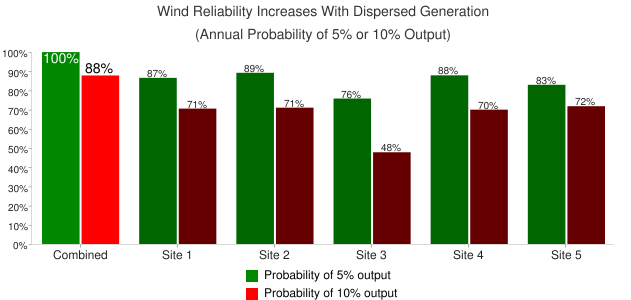
Combining the output of the five sites also increases the probability that the output will be at least 5% or 10% of total capacity of the wind turbines.
Other studies have reinforced these findings. For example, a report by Cristina Archer and Mark Jacobson in 2007 found that dispersing wind at 19 sites over an area the size of Texas increased the level of guaranteed output by 4 times. Wind power could not be the sole source of electricity for the grid without massive overbuilding of capacity, but its variability is an argument for more dispersed wind, rather than less of it. 
|
 The output from a single wind turbine can vary widely
over a short period of time, as wind goes from gusty
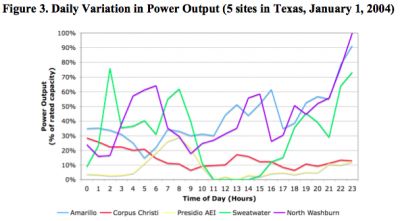
to calm. The adjacent graphic (from this report)
illustrates how a single turbine in Texas provided
varying power output over a single day, varying from
under 20 percent of capacity to near 100 percent!
The output from a single wind turbine can vary widely
over a short period of time, as wind goes from gusty
to calm. The adjacent graphic (from this report)
illustrates how a single turbine in Texas provided
varying power output over a single day, varying from
under 20 percent of capacity to near 100 percent!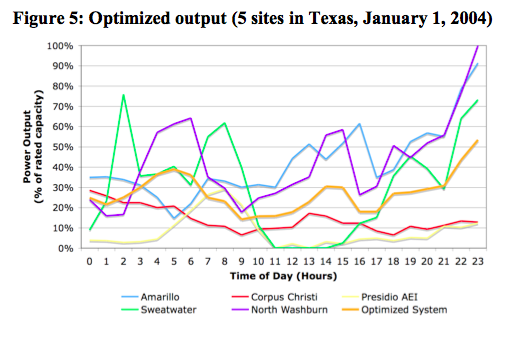
Updated: 2003/07/28