National Energy Grid
|
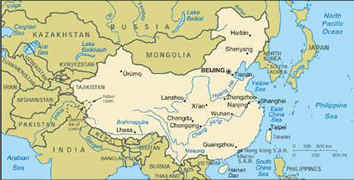 |
|
Full Size Map National Electricity Transmission Grid of China (350 kb) |
GRID SUMMARY
As with coal, China's electric power industry experienced a serious oversupply problem in the late 1990s, due largely to demand reductions from closures of inefficient state-owned industrial units, which were major consumers of electricity. The Chinese government responded to the short-term oversupply in part by implementing a drive to close down small thermal power plants and by imposing a moratorium (with a few exceptions) on approval of new power plant construction, which ran through January 1, 2002. Until recently, the backlog of projects approved in the mid-1990s had kept pace with demand increases. In the first half of 2003, however, the Chinese government has approved 30 major new electric power projects, with a total of around 22 gigawatts (GW) of capacity. Construction has begun on 17 of these projects. A total of 18.5 GW of new capacity is scheduled to be completed this year.
The largest project under construction, by far, is the Three Gorges Dam, which, when fully completed in 2009, will include 26 separate 700-MW generators, for a total of 18.2 GW. Plans were announced in March 2002 to reorganize the Three Gorges project into the China Yangtze Three Gorges Electric Power Corporation. The corporation is expected to seek capital through an equity offering open to foreign and domestic investors, similar to those already carried out by the major Chinese oil companies. The IPO has been scheduled for September 2003. The reservoir created by the dam began to fill in June 2003, and the first test runs of the initial group of electric turbines is set for August 2003. Another large hydropower project involves a series of dams on the upper portion of the Yellow River. Shaanxi, Qinghai, and Gansu provinces have joined to create the Yellow River Hydroelectric Development Corporation, with plans for the eventual construction of 25 generating stations with a combined installed capacity of 15.8 GW.
Many of the major developments taking place in the Chinese electricity sector recently involve nuclear power. China's total installed capacity for nuclear power generation increased from 2.1 GW at the beginning of of 2002 to 5.4 GW at the beginning of 2003. The first generation unit of the Lingao nuclear power plant in Guangdong province began commercial operation in May 2002, with a capacity of 1-GW. The second 1-GW generating unit began operating in January 2003. An additional 600-MW generating unit at the Qinshan nuclear power plant in Zhejiang province began operation in February 2002, and another 600-MW unit at the same site came online in December 2002.
A major issue for China's electric power industry is the distribution of generation among power plants. China's stated intention eventually is to create a unified national power grid, and to have a modern power market in which plants sell power to the grid at market-determined rates. In the short term, though, traditional arrangements still hold sway, and state-owned power plants which have government connections tend to have a higher priority than independent private plants. Additionally, some private plants with "take-or-pay" contracts, which provide for guaranteed minimum sales amounts, have had trouble getting the provincial authorities running the local grids to honor those terms.