Policy Options: Subsidies
Removing subsidies on fossil fuels will stop energy
price distortions, thereby increasing the market competitiveness
of renewables!
Global Environmental
Facility
"Moderating or, when possible,
phasing out fossil fuel subsidies, is fundamental
to improving market conditions for energy efficiency
and renewable energy markets. Tax and subsidy
policies should treat fossil fuels and renewable
energy equally."
|
International
Energy Agency
Benefits of subsidy elimination
would not only ameliorate ecological damage
and climate change.
"Getting the price right"
would promote energy security, stimulate economic
growth, boost renewable private investment,
and would increase the use of new energy technology.
Eliminating artificial subsidies makes electricity
production more reasonable and lucrative.
|
A subsidy is government funding given to a private
person or entity, intended to benefit the good of
society. Subsidies are used to make certain activities
cheaper when the activity's benefit is not represented
in the financial costs. For example, energy subsidies
that make it cheaper to produce or buy energy have
been justified to increase access to electricity,
providing a higher standard of living to society.
Industrialized countries have used this 'public good
perspective' to rationalize many forms of subsidies,
including tax concessions and direct grants to fossil
fuel production. While some fossil fuel subsidies
have decreased, they are still estimated to be about
$150 billion per year globally, many in industrialized
nations.
Developing nations' energy subsidies primarily have
not been successful - leading to inefficient public
utilities. The utilities are plagued by poor service
and power outages, wasted resources, inability to
draw in investment revenues or attract aid from public
or private investors. Developing and transitional
governments know that reducing conventional energy
subsidies will not only help with these problems,
but also help their ability to fund other development
objectives. (UNDP)
While some people argue that no subsidies are justified,
others are promoting temporary subsidies for renewables.
The history of subsidizing fossil fuels (thereby altering
their price) has made it difficult for renewable energy
resources to compete. Governments should temporarily
provide funding for new energy technologies so that
they can become market competitive with traditional
energy resources.
Fossil fuel subsidies negatively affect the marketplace:
Economic Impact:
- Subsidies consume federal money: Globally, $300
billion dollars is spent annually on nuclear/fossil
power subsidies. This restricts funds needed for
investments and other development projects. See
World
Council on Renewable Energy
- Removing fossil fuel subsidies has been shown
to promote economic development in Colombia, Ghana,
Indonesia, Turkey and Zimbabwe where GDP grew faster
after subsidy reform The
Earth Council
Environmental Impact:
- A per-unit subsidy on fuel production causes
energy prices to drop and quantity of fuel produced
to rise, thereby increasing carbon dioxide emissions
and pollution. An OECD study showed that global
CO2 emissions would drop
more than 6%. if all global fossil fuel subsidies
were removed, real income would increase by 1.6%
in non-OECD countries and by 0.1% in OECD countries
by 2010 . Also, eliminating consumer subsidies in
non-OECD countries would raise income by $35 billion.
Earth Council
Social Impact:
- Dependency and national insecurity are deepened
by oil, gas and coal subsidies
- Low-income neighborhoods are disproportionately
affected by pollution in cities from electricity
plants, transportation exhaust and industry run
by conventional energy
Effect on renewable energy resources:
- Conventional subsidies inhibit research for new
technologies by supporting inefficient fuels: Producers
receive artificially low prices for fossil fuels,
so the return on their investment decreases for
R&D in renewables and new infrastructure.
See UNEP
for a paper on the advantages of subsidy removal and
removing financial barriers of renewable energy use
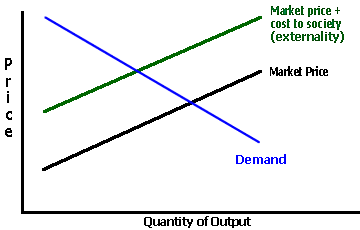
Table
1
Two scenarios can be demonstrated with this graph.
First, we can see how, without accounting for
negative externalities (i.e. pollution), prices
will be artificially low. With the same demand
curve, the market will set the supply at the market
price. As you can see, where the demand curve
intersects with the market price, this results
in inefficiency- too much output at a reduced
price. Governments benefit society when they set
policy to include
externality costs into the market price.
Also, we can demonstrate how a subsidy works.
Subsidizing a fuel artificially lowers the price
curve to the lower position (market price graph).
Since we spend $150 billion on conventional fuel
subsidies, and also don't include the externalities
in price to the consumer or industry, fossil fuels
are cheaper. Minimizing these subsidies and/or
creating temporary subsidies for renewables will
help make the relative prices for all fuels more
realistic. |
Subsidy reform: Replace old subsidies
with temporary ones that promote clean energy use
International
Energy Agency/United Nations
A 'good subsidy' is one
that enhances access to modern energy or has
a positive impact on the environment, while
sustaining incentives for efficient delivery
and consumption
|
We must be careful when creating any type of subsidy.
However, temporary subsidies for renewable energy
can be beneficial, if a few criteria are followed.
These subsidies can promote the needed competition
for clean energy technologies and boost their capacity
(leading to natural price reductions). Fossil fuels
currently monopolize the market because of government
assistance- it is only fair to give all fuels an
equal chance to be competitive. Subsidizing renewables
helps boost energy access to rural developing communities
and lowers prices for renewables in industrialized
nations to make them more cost-competitive. These
subsidies can be justified because they lead to
better health worldwide, to enhanced energy security
and to sustainable development goals.
Types of energy subsidies
> Table 2
(click to expand table)
Necessary components of subsidy legislation
- Sunset clause!! We must not become dependent
on subsidies. The policy should have a reasonable
schedule to gradually lessen the subsidy
- Transparency: The public must be able to
find out how much the government spent on the subsidy
and which people and/or groups received subsidy
money
- Well-targeted: It must be directed to people
who are meant and deserve to benefit from them.
Too often a subsidy benefits energy companies and
the wealthy disproportionately (i.e. LPG subsidies
in India), so consider more local targeted projects
- Efficiency: Subsidies should boost, not
undermine a supplier's incentive to provide or a
consumer's ability to use the energy supply
- Cost effective: Perform a cost-benefit
analysis
- Practical: The subsidy must be affordable
and reasonable to administer
Case Studies
Resources:
Reforming
Energy Subsidies, The impact of energy subsidies
on sustainability, UNEP/IEA Workshops
Energy
for Sustainable Development, A Policy Agenda,
UNDP
|