Policy Index >> Policies to Promote Renewable Energy Policies to Promote Renewable EnergyProgressive policy-making has the greatest impact on our renewable energy future. We have gathered what we believe to be the most effective government policies around the world to promote renewable energy technologies. Studies show that the world is blessed with renewable resources. There is enough potential capacity on each continent to meet the world's entire power generation requirements without the use of fossil fuels. In the past decade, technology costs have dropped dramatically - yet the key driver for getting renewables onto the grid has been forward-thinking policy-making at the local, state and federal levels.Pertinent Questions:
Q: Why are we interested in accelerating the use of renewable resources for electricity and transportation fuels?GENI focuses on extending access to electricity (through the grid) while tapping renewable sources to create the electricity. Energy, specifically electrical energy, provides the foundation of our modern society. It supports our transportation system, communications, water and waste treatment, agriculture, health care, lights and computers. 1.7 billion people on our planet still have no access to electricity and live in daily struggle just to survive. Access to electricity and fuel essentially determines our standard of living, providing us with education, nutrition and economic opportunities. We advocate sustainable development, meaning that while we must increase energy access, it should not compromise the ability of future generations to live well. Conventional sources of energy pose significant threats to our current and future global security, environmental quality, health and social well being. Renewable energy sources mitigate the negative effects of fossil fuel use. Solar, wind and geothermal power, for example, do not contribute to global climate change, will not run-out and are available to everyone around the globe.
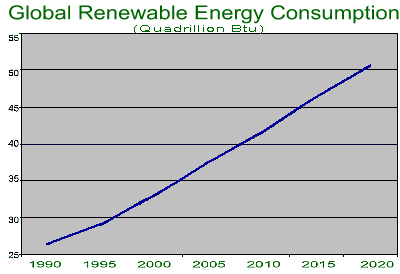
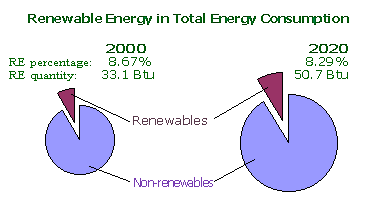
Renewable power resources are abundant around the world. Then, why haven't we already switched from fossil fuels to renewables? We are deeply dependent on the use of fossil fuels, and consequently, significant barriers exist to mainstreaming renewable energy use. According to the United Nations Development Program (UNDP),
Graph 1
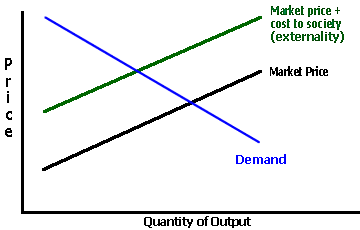
Reference: Renewable Energy into the Mainstream, International Energy Agency Q: How will changing government policy affect the future usage/adoption of renewables? Can't we depend on the power of the free market?Traditionally, governments have intervened in the energy sector because they considered access to energy to be a public good. When a good or service innately benefits society, but the benefit is not captured in the market price, this product tends to be underproduced. Energy is a public good because it empowers communities and benefits one's standard of living. Consequently, governments have justified providing subsidies and widening access through public ownership and regulation (UNDP 43). Now the world faces risks from global climate change and local ecosystem destruction due to the carbon dioxide emissions and other pollutants from fossil fuel combustion. These costs to society (externalities) are not included in the price for fossil fuel energy production.
The market needs help to incorporate negative externality costs into market prices. If we were to wait for the market to make renewable energy cost-competitive, it would be too late to reverse the effects of climate change, ecosystem destruction and pollution. Governments have the opportunity to accelerate the use of renewable resources through effective policy measures. Currently, one of the biggest obstacles to mainstreaming renewables is that they are not cost competitive. Governments have the option to create policy that affects the price of both fossil and renewable fuels through subsidy reform and taxes. Also, funding renewable energy production or accelerating consumption through electricity feed-in laws, technology procurement, concessions, targets and tradable certificate programs will also lead to more equalized prices.
Q: What are the best policy options for promoting consumption/production of renewables?Table 1
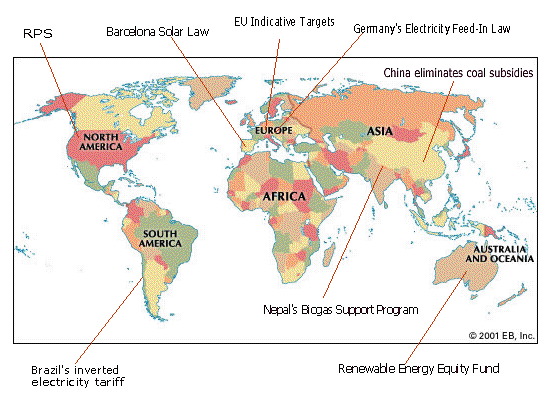 Q: How does a policymaker decide which policy instrument is best for his/her country?Clearly, each country faces different barriers to mainstreaming renewable energy. Developing nations' priority is increasing energy access to all people, while encouraging economic development and sustainable lifestyles. Economies in transition must encourage competition in their energy markets in order to draw investment. Industrialized countries have established oil dependencies maintained by subsidies, corporate power and the public's reluctance to change. However, encouraging competitive energy markets in all nations around the world will accelerate the use of renewables.Developing Nations: The unstable markets in developing nations lack competition because investors do not want to put money into weak economies. These nations can focus their policy on attracting domestic and foreign investment and possibly restructuring publicly owned energy entities (6)*. However, privatizing the energy industry is tricky and may have unwanted side-effects such as social unrest and political instability. For developing and transitional countries, it is increasingly evident that reducing fossil fuel subsidies will improve their energy problems. "Reducing or eliminating subsidies provides internal revenues for investment, improves the prospects of attracting direct foreign investment, and improves the financial capacity of governments to pursue other development objectives" states the UNDP (57). Subsidies that underprice electricity have cost developing nations $130 billion a year for the past decade. The UNDP suggests a better solution for developing nations would be to reform subsidy programs by focusing them on financial, social and environmental sustainability. In addition, fundamental legal, institutional and social reforms will help attract energy sector investment. Also, local renewable projects, such as Barcelona's Solar Law have been successful because they combine government action with enough individual control to stimulate market competition (117). Industrialized Nations: In industrialized nations, which already have sufficient investors and well-functioning markets, policies can concentrate on leveling the playing field for all competitors (7). Both removing subsidies and internalizing the social costs of burning fossil fuels will help eliminate market price distortions. Societies that want to account for external costs can create emission taxes, fiscal incentives (investment grants, tax credits, guaranteed prices for renewables), use ethical persuasion by educating the public on social costs of using energy sources and can implement certificate trading programs. Other ways for industrialized countries to accelerate the use of renewables include setting targets, implementing renewable portfolio standards and certificate and emissions trading programs. All of these options allow flexibility for companies to chose the manner in which they increase the percentage of total renewables they produce and consume. Setting technology standards, such as vehicle emissions standards, ensure that companies develop cleaner technology, but also provide flexibility for their R&D. Research and development of new energy technologies is important for all countries. In industrialized countries, current pricing systems provide few incentives for private investment; private companies also tend to invest in short term R&D, so public money should be spent on long-term development and demonstration. Developing nations must dedicate public funds to renewable R&D because technologies most adaptable to their communities (e.g., decentralized rural electrification) tend to be under-funded in industrialized nations. To complement the R&D, capacity building must be implemented to ensure the energy technology will be used effectively and maintained properly. "Few energy technologies have reached maturity without substantial public sector investment"UNEP/IEA Workshops, Reforming Energy Subsidies References:
Research and web design by Sara Kamins, GENI Senior Research Associate | ||||||||||||||||||||||