 Policy Options: Electricity Feed-in LawsCase Study in Germany
In the past twenty years, electricity feed-in laws have been popular in Denmark, Germany, Italy and in Spain. Private generators, or producers, charge a feed-in tariff for the price per unit of electricity the suppliers or utility buy. The rate of the tax is determined by the federal government. In other words, the government sets the price for electricity in the country. Because the producer is guaranteed a price for the electricity, if he meets certain criteria, feed-in laws help attract new generation capacity. The benefits of feed-in tariffs include: 1. They catalyze large installments of renewable electricity 2. They ensure technically efficient operation of the plant 3. The transaction costs and administrative costs are low 4. They reduce risk in business plans for new investment 5. They allow small cooperative groups and companies to participate
Germany's Stromeinspeisungsgesetz: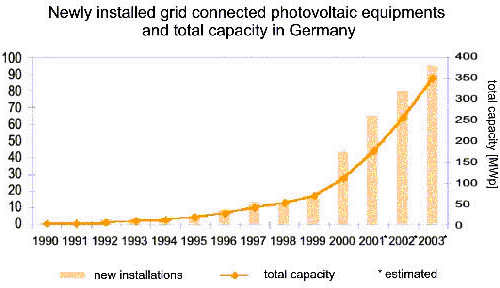 PREDAC, European Actions for Renewable Energies In the last four years, Germany quadrupled its installed PV capacity and became the world leader in wind development. Much of this success is due to Stromeinspeisungsgesetz, literally meaning the Law on Feeding Electricity from Renewable Sources into the Public Network. This Electricity Feed Law sets the price for renewable electricity sources at 90% the retail residential price. There are a few exceptions, one for example being that small utilities whose average electricity price would raise significantly are exempt. Consequently, in the 7 years (1991-1997) following the passage of the law, grid-connected PVs rose from 2 MW to over 11 MW- a 450% jump. Prices also fell during the same period, from 27,000 to 17,000 deutsche marks per kW. In 2002, Germany installations were at 85 MW! This policy success is attracting companies such as Shell and RWE Schott to invest in German PV, with projects to produce 9 and 24.5 MW respectively in 2002. Because of the Electricity Feed Laws, Germany pays wind turbine owners about 9 cents/kWh. For photovoltaics, Germany pays 50 cents/kWh for projects less than 5 kW (Gipe). Resources:Renewable Energy Policy Project, Renewable Energy Policy Outside the US Electricity Feed Laws in Europe, by Paul Gipe PV Market Update, Renewable Energy World |