




|
Thursday, 17 October, 2002, 08:05 GMT 09:05 UKAfrica's grand power exporting
plans
|
|||||||||||||||


 |
|
 |
|
| By Briony Hale BBC News Online business reporter |
|
 |
|
|
|
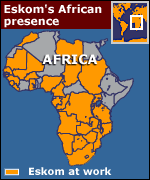
"It's going to happen, it's just a question of how fast we can do it," said Jan de Beer, managing director of Eskom Enterprises, the pioneering South African electricity firm.
 Africa's got everything
- it's just a matter of developing it
 |
|
Jan de Beer
Eskom Enterprises |
"Africa's got everything - the resources, the raw materials and the energy," he says.
"It's just a matter of developing it.
"If things go well, we'll have an African grid within four or five years."
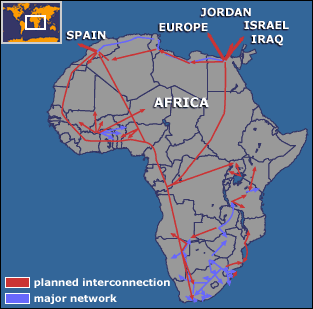
When Africa is all linked up, so the plan goes, supply will far outstrip local demand, allowing Africa to export cheap power across the Mediterranean to Spain, Jordan and beyond.
At the crossroads
Eskom's vision for a pan-African electricity grid centres around the Inga river in the Democratic Republic of Congo.
A bend in the river - where the Inga falls 96 metres in nine miles - is thought to be Africa's largest potential source of hydroelectric power.
|
The existing dam is already supplying electricity to Zambia, Zimbabwe, Rwanda and South Africa.
More dams could unleash far more power than the whole of Africa's needs put together.
And those transmission lines could then transport electricity north west to Nigeria, and north east to Egypt, a feasibility study funded by the African Development Bank found.
Then there is Angola, which still flares gas from its oil fields - gas which could be turned into 30,000 megawatts of electricity rather than wasted.
Nepad's stamp of approval
"The potential for power in that part of the world is so enormous, and they're sitting on the crossroads of the whole of Africa," says Mr de Beer.
"We're already linked electrically to Congo, if we work up to Cameroon and Congo you've got one power network into west Africa."
If Eskom can build the
network, then the southern European market
is definitely there
|
|
Cindy Galvin
Argus Power |
From there, it's up to north Africa and through Algeria or Morocco to Spain and Italy.
The key interconnectors needed are part of the Nepad plan - Africa's home-grown development plan - something which Mr de Beer sees as very positive in getting the projects off the ground.
Morocco exported electricity to Spain for the first time last winter.
And plans are already well underway to connect Algeria to Spain alongside the existing gas pipeline.
Technical trouble
"If Eskom can build the network, then the southern European market is definitely there," said Cindy Galvin, editor of Argus Power Europe.
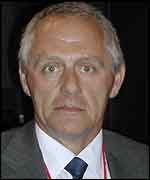
Jan
de Beer: Innovative thinking is needed
|
"Italy and Spain have some of the highest electricity prices in Europe and both are keen to import cheaper power."
Despite the optimism, other energy experts have questioned the wisdom of the project, worrying about compatible frequency between countries and cross-border disputes.
And a relatively high proportion of electricity is lost when power is transported across large distances.
The highly efficient French grid loses up to 3% of its electricity in the network, while countries such as Hungary lose up to 12% of their output.
Investment crunch
And then there's the question of finding the necessary money to make it all happen.
"I think the funds are there, if you construct your project properly," says an undaunted Mr de Beer.
Eskom itself is prepared to commit up to 4bn rand ($381m; £245.5m) over the next four years.
"It's a matter of finding sufficient resources to do the planning, get certain anchor customers in place, and combine it with the roll-out of telecoms cables so that the whole thing makes financial sense," he says.
"It's just a case of innovative thinking."
Email this page to a friend

If you speak another language fluently and you liked this page, make
a contribution by translating
it! For additional translations check out FreeTranslation.com
(Voor vertaling van Engels tot Nederlands)
(For oversettelse fra Engelsk til Norsk)
(Для дополнительных
переводов проверяют
FreeTranslation.com )